


Thinking about studying abroad in Australia? You’re not alone. It’s a top pick for students from all over the world, and for good reason. You get a world-class education, sure, but you also get an incredible lifestyle to go with it. It’s the perfect mix of serious study and amazing life experiences, from exploring stunning landscapes to kick-starting your career.
This guide is your end-to-end playbook for making it happen.
So, Why Pick Australia for Your Studies?

Choosing where to study overseas is a huge decision, but Australia makes a pretty compelling case for itself. It’s much more than just kangaroos and beautiful beaches. We’re talking about a genuine global education leader that pulls in students who want both a top-tier degree and a fantastic quality of life. The real magic is in its blend of innovative teaching, vibrant multicultural cities, and a genuinely welcoming vibe.
And this isn't just a feeling; the numbers back it up. Australia has seen a massive boom in international students. Recently, the number of international student visa holders hit a peak of 608,262. That’s a whopping 191% increase from 2006, a period where the local population only grew by 33%. It just goes to show how vital international students have become to Australia’s culture and education scene. The Institute of Public Affairs has some interesting data on this if you want to dig deeper.
It’s Not Just About What Happens in the Classroom
What really makes the experience of studying in Australia special is the lifestyle that comes with it. Your classes are often linked with hands-on learning that gets you out of the lecture hall and into the real world. Imagine studying marine biology on the Great Barrier Reef or getting your business degree in the middle of Sydney's hustle and bustle.
Plus, Aussie universities are known globally for their high standards and incredible research. That kind of reputation opens up some seriously good post-grad work opportunities, letting you launch your career on an international stage right after you toss your graduation cap.
Honestly, the real win is the combination of a great degree and the life skills you pick up along the way. You learn how to be independent, figure out a new culture, and build a network of friends and contacts from all over the world.
A Welcoming and Diverse Vibe
Aussie cities are total melting pots of culture, which creates a really inclusive and friendly environment for international students. You’ll see this diversity everywhere, from your university campus to the local weekend markets, making it so much easier to settle in and feel like you belong.
This guide will walk you through everything, step-by-step. We'll cover everything from picking the right uni to finding awesome student deals to make your money go further. Let's get you ready for this life-changing adventure.
Choosing the Right University and Course
Deciding where to study in Australia can feel like you're staring at a giant map with hundreds of pins scattered all over it. With 43 universities to pick from, each offering its own unique vibe, how on earth do you even start?
The secret is to look past the shiny brochures and big-name rankings. You need to find a place that actually clicks with your personal ambitions and career goals.
Australia's uni scene is incredibly varied. You've got everything from massive, research-heavy campuses in bustling cities like Sydney and Melbourne, to smaller, specialised colleges in regional towns that have a real tight-knit community feel.
Cracking the Code of University Groups
A good way to start making sense of it all is to get familiar with the different university networks. These aren't official rankings, but they give you a pretty good idea of what each uni is all about.
- Group of Eight (Go8): These are the heavy hitters, Australia's leading research-intensive universities. Think of them as the Aussie equivalent of the Ivy League. If you're gunning for a career in academia or a field that needs some serious brainpower and research skills, a Go8 uni could be your perfect match.
- Australian Technology Network (ATN): This crew of five universities is all about practical, real-world learning and solid industry connections. Their courses are built to get you job-ready, often packing in internships and work placements. If you learn best by doing and can't wait to get into your career, an ATN uni is probably more your speed.
- Innovative Research Universities (IRU): This network is big on inclusive education. They focus on turning solid research into things that actually help the community. They have a strong commitment to making sure everyone gets a fair go, offering amazing learning experiences for students from all walks of life.
A uni's network tells you a lot about what they stand for. Figuring out whether you want a research-focused institution or one with strong industry ties is one of the biggest decisions you'll make.
Thinking Beyond the Rankings
It’s tempting to just Google "best universities in Australia" and call it a day, but rankings don't paint the whole picture. The number one uni for overall research might not be the best place for your specific course in, say, digital media or marine biology.
Think of it this way: if you're passionate about environmental science, you might be way better off at a regional uni right next to the Great Barrier Reef. The hands-on fieldwork opportunities you'd get there could be way more valuable for your career than a degree from a higher-ranked city uni that's miles from the action.
Instead of getting hung up on one number, dig into the stats that actually matter to you.
- Course-specific rankings: How does the uni stack up for the subject you want to study?
- Student satisfaction: Are the current students actually happy with the teaching and support they're getting?
- Graduate employment rates: What percentage of grads land a full-time job within a few months of finishing up?
Finding Your Perfect Course
Once you've got a shortlist of unis, it’s time to get into the nitty-gritty of the courses themselves. Don't just assume a "Bachelor of Business" is the same everywhere, because it's definitely not.
For instance, one uni's business degree might be all about finance and data analytics, while another's is geared towards entrepreneurship and marketing, complete with its own startup incubator program. You have to read the course outlines. Check out the specific subjects you'll be taking, how you'll be graded (is it all exams, or a mix of projects and presentations?), and what kind of internship opportunities are on offer.
It’s also super important to check the entry requirements. This usually boils down to two things:
- Academic Prerequisites: You'll need to prove you have the equivalent of an Australian Year 12 qualification. For some degrees, you might also need to have studied specific subjects like advanced maths or chemistry.
- English Language Proficiency: You’ll have to hit a minimum score on a recognised English test like IELTS, TOEFL, or PTE Academic. The score you need can change a lot depending on the uni and the course.
Honestly, putting in the hard yards with your research now is the best investment you can make. It's the difference between landing in a place that just gives you a degree, and finding a place that feels like the perfect home for your Aussie adventure.
Navigating the Student Visa Application
Alright, let's talk about the big one: securing your student visa. This is one of the final, most crucial hurdles in your journey to study in Australia. The whole process can feel a bit daunting with all the timelines and paperwork, but I promise, if you break it down into smaller pieces, it’s completely manageable. The absolute key? Planning ahead. It will save you a world of last-minute stress.
Honestly, the smart move is to start thinking about this long before you even get your acceptance letter. Most of us who've been through it would recommend starting your research and prep 12 to 18 months before you plan to start your semester. This gives you a comfortable amount of breathing room to check out unis, get your documents in order, and hit every deadline without breaking a sweat.
This visual timeline gives you a great overview of the whole university application journey, which is the essential first step before you can even touch the visa stuff.
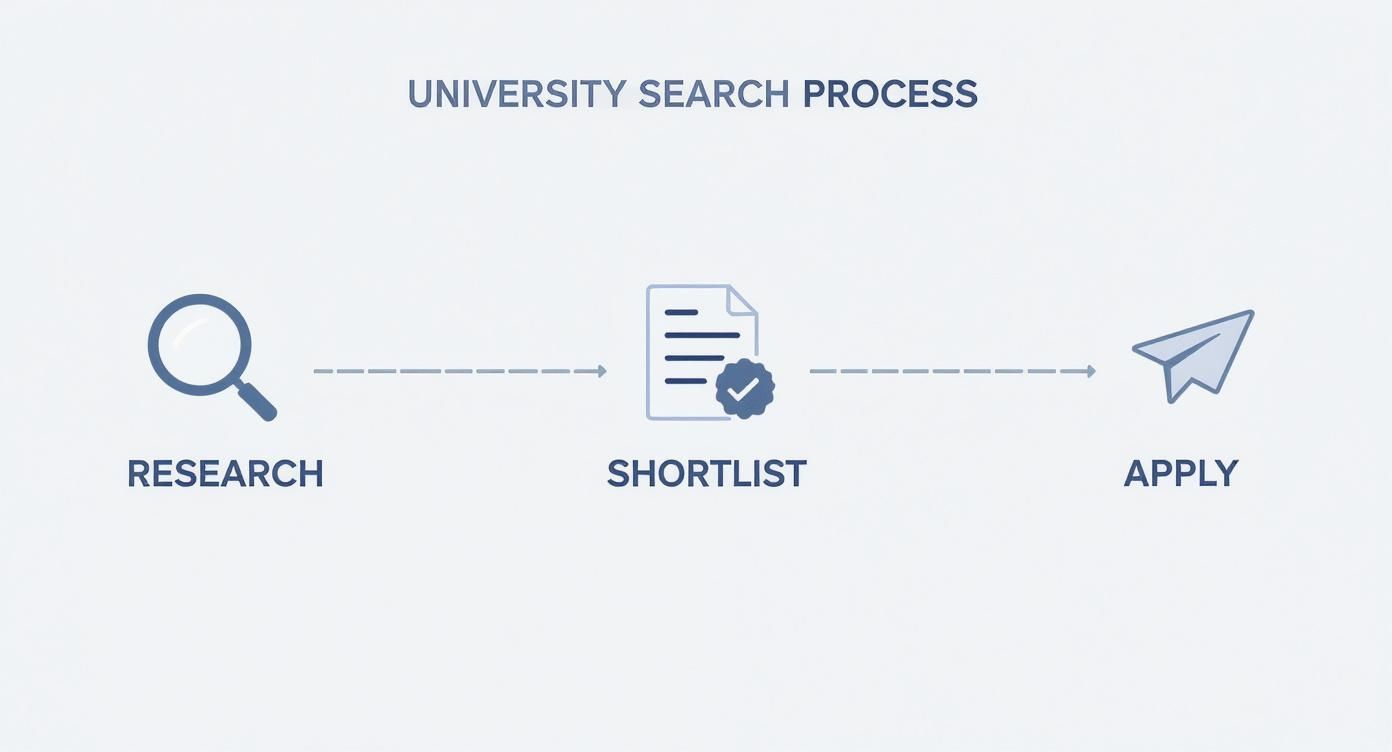
As you can see, getting from that initial "hmm, maybe Australia?" phase to actually submitting your application is a marathon, not a sprint. Taking your time here means you can make better choices and build a stronger application, which will make the visa part of the process a whole lot smoother.
Keeping Up with Recent Policy Changes
Things change, and that’s especially true for international student policies in Australia. The government is always making adjustments, so it's super important to stay on top of the latest requirements. Recently, there have been a few key updates aimed at managing the number of students and keeping the quality of education high.
We're talking about things like stricter English language test scores, different visa application fees, and new rules for post-study work rights. These changes are all about making sure the international education sector grows in a way that works for everyone. You can get a good breakdown of these new rules and how they might affect you by reading up on the latest policy adjustments for international students on economictimes.com.
Getting Your Essential Documents Together
So, you've accepted your offer and paid your deposit—congrats! The next thing you'll get from your uni is a Confirmation of Enrolment (CoE). This piece of paper is your golden ticket to starting the Student visa (subclass 500) application.
Once you have your CoE in hand, it's time to gather the rest of your documents. The government needs to see proof of who you are, what you've studied, and that you can support yourself financially. The exact checklist can differ slightly, but you’ll almost certainly need:
- Your valid passport and certified copies of your birth certificate.
- Your Confirmation of Enrolment (CoE) for every course you plan to take.
- Proof of English language proficiency, like your official IELTS or TOEFL results.
- Academic transcripts and graduation certificates from your previous schooling.
- Evidence of sufficient funds to cover your tuition, travel, and living expenses.
- Proof of Overseas Student Health Cover (OSHC) for your entire stay.
Australian Student Visa Application Timeline
To give you a clearer picture, here’s a simplified timeline. Think of it as a roadmap to keep you on track from the university hunt right through to your visa application.
| Timeframe Before Semester Start | Action Item | Key Considerations |
|---|---|---|
| 12-18 months | Research universities and courses. | Check entry requirements, course content, and institution reputation. |
| 9-12 months | Prepare and sit for English proficiency tests. | Book your test early (IELTS, TOEFL, etc.) and allow time for results. |
| 6-9 months | Submit university applications. | Pay close attention to application deadlines for your chosen intake. |
| 4-6 months | Receive Letter of Offer and accept it. | Pay your deposit to receive your Confirmation of Enrolment (CoE). |
| 3-4 months | Gather visa documents and apply for the visa. | You need your CoE before you can apply. Start gathering proof of funds and OSHC now. |
| 1-3 months | Receive visa grant notification. | Visa processing times can vary, so apply as soon as you have all your documents. |
| 1 month | Book flights and arrange accommodation. | Once your visa is approved, you can lock in your travel and living arrangements. Welcome! |
This timeline isn't set in stone, but it’s a great guide to follow. Starting early and tackling one step at a time is the best way to avoid feeling overwhelmed.
Crafting a Compelling Genuine Student Statement
This is a big one. The Genuine Student (GS) statement has replaced the old GTE requirement, and it’s a critical part of your application. This is your chance to speak directly to the Department of Home Affairs and convince them that your main reason for coming to Australia is genuinely to study.
This is not just a box-ticking exercise. You’ll need to answer specific questions that paint a clear picture of your situation and intentions.
Think of your GS statement as your personal story. It needs to connect the dots between your past education, why you've chosen this specific course at this specific uni in Australia, and what your career plans are for the future. Generic, copy-paste answers just won’t work here.
To nail your GS statement, focus on these areas:
- Explain Your Course Choice: Get specific. Why this course? Why this university? Show them you've done your homework and this isn't just a random choice.
- Detail Your Future Plans: What's the game plan after you graduate? You need to link your Australian degree to your long-term career goals back in your home country or somewhere else (just not Australia).
- Address Your Ties to Home: Talk about your life back home—family, community, financial ties. This helps show that you have strong reasons to return after you finish your studies.
Take this statement seriously. A thoughtful, well-written GS statement can truly be the difference-maker in getting your visa approved and kicking off an incredible chapter of your life.
Budgeting for Your Australian Adventure
Alright, let's talk money. Nailing your finances is a massive part of planning your study abroad adventure, and getting it right from the start means less stress and more exploring. Honestly, mapping out a realistic budget is your first real step towards financial freedom Down Under.
The cost of living can swing wildly depending on where you set up camp. Big cities like Sydney and Melbourne are incredible, but they definitely come with a higher price tag—especially when it comes to rent. On the flip side, picking a uni in a smaller city like Adelaide, Perth, or Brisbane can seriously slash your weekly spending, freeing up more cash for the fun stuff.
Understanding the True Cost of Living
Tuition and rent will be your two biggest hitters, no doubt. But it's the day-to-day costs that you really need to get a handle on. To give you a rough idea, the Australian Government recommends international students budget around AUD $21,041 a year just for living expenses. Think of this as a starting point.
Here’s a quick look at what a monthly budget might shake out to be, comparing a major city to a regional one.
| Expense Category | Sydney/Melbourne (Est. Monthly) | Regional City (Est. Monthly) |
|---|---|---|
| Rent (Share House) | AUD $1,200 – $1,600 | AUD $800 – $1,100 |
| Groceries | AUD $400 – $600 | AUD $350 – $500 |
| Public Transport | AUD $150 – $200 | AUD $100 – $150 |
| Phone & Internet | AUD $70 – $100 | AUD $60 – $90 |
| Entertainment & Social | AUD $200 – $400 | AUD $150 – $300 |
| Total Estimated Monthly | AUD $2,020 – $2,900 | AUD $1,460 – $2,140 |
Of course, these are just ballpark figures. Your personal spending habits will make a huge difference, but it shows how much location can impact your bank account.
Smart Saving Strategies That Actually Work
You’ll get good at making your money go further, fast. It’s not about missing out on experiences; it’s just about being smarter with your spending.
- Become a Public Transport Pro: The second you can, get a student concession card (like an Opal in Sydney or Myki in Melbourne). It'll give you discounted fares on trains, buses, and ferries, which is way cheaper than depending on rideshare apps.
- Get Friendly with Your Kitchen: Eating out all the time will drain your funds like nothing else. Your best bet is creating a budget-friendly meal plan. Also, hitting up local spots like Paddy's Market in Sydney or the Queen Victoria Market in Melbourne can save you a fortune on fresh food.
- Flash That Student ID: Seriously, your student card is pure gold. From cheaper movie tickets to discounts on laptops and clothes, always ask if there’s a student price. Check out sites like Student Wow Deals, too. They’re brilliant for sniffing out exclusive savings on everything from food to flights. You can even find awesome student travel discounts to help you see more of the country without breaking the bank.
Your budget isn’t a ball and chain; it’s a tool. It gives you the power to spend consciously so you can actually afford the experiences that matter most while you're studying in Australia.
Essential First Financial Steps
Once you land, a few simple tasks will set you up for financial success. First on the list: open a local Australian bank account. It makes paying bills, getting paid from a job, and just managing your cash so much easier. Plus, you’ll dodge those killer international transaction fees. Big banks like Commonwealth Bank, NAB, ANZ, and Westpac all have great student accounts with low or zero monthly fees.
Next, get familiar with your work rights. If you’re on a Student visa (subclass 500), you’re allowed to work up to 48 hours per fortnight while your course is in session and full-time during scheduled breaks. They are super strict about this, so you absolutely have to keep track of your hours.
Finding a part-time job is a fantastic way to bring in some extra cash and really dive into the local scene. Gigs in hospitality (cafes, bars) and retail are always popular with students because the hours are usually pretty flexible. Your uni’s job board is a great place to start, along with websites like Seek and Indeed. A job won’t just help your budget—it’ll grow your social circle and give you some solid work experience.
Finding A Place To Call Home

Landing in Australia is exciting—but the first thing on your mind will likely be where you’ll rest your head each night. After you’ve sorted courses and visas, finding a safe, affordable spot really shapes your day-to-day life abroad.
Tens of thousands of international students arrive here every year. In fact, Australia saw 925,905 enrollments last year, with about 27% of university rosters made up of non-locals. That means competition for rentals can be fierce. Find the full breakdown at how student numbers impact Australian cities at macrobusiness.com.au.
Exploring Accommodation Options
There’s no single right answer when it comes to student housing. Your budget, social style and need for independence will steer you toward the best fit.
• On-Campus Colleges
Often called residential colleges, these spots put you steps from lectures and dining halls. You’ll pay a premium, but breakfast, dinner and peer support are usually included.
• Purpose-Built Student Accommodation (PBSA)
Modern blocks with shared lounges, gyms and study areas. You’ll enjoy more privacy than a college but still join in events and meet fellow students.
• Private Rentals (Share Houses)
Splitting a flat or house keeps costs down. You deal with bills, landlords and housemates, but you also gain full control of your space.
• Homestay
Live with an Australian family—meals and a welcoming environment come standard. It’s perfect for language practice, though you’ll have a few more house rules to respect.
Comparison Of Student Accommodation Options In Australia
Below is a quick snapshot to help you weigh up average costs, benefits and drawbacks.
| Accommodation Type | Average Weekly Cost (AUD) | Pros | Cons |
|---|---|---|---|
| On-Campus Colleges | $450–$550 | Proximity to classes; meals and support included | Highest price point; less privacy |
| Purpose-Built Student Accommodation | $300–$450 | Modern facilities; built-in community | Rents can spike in popular locations |
| Private Rentals (Share Houses) | $150–$300 | Lower rent; total independence | Utility bills and cleaning responsibilities |
| Homestay | $235–$340 | Cultural immersion; meals supplied | Limited freedom; set house rules |
That table should give you a clearer picture of what’s out there. Ultimately, your daily lifestyle and budget will guide which option feels most like home.
Searching And Applying Smartly
Beginning your hunt before you arrive is totally doable—just arm yourself with trusted platforms and patience.
Start with major real estate sites:
- Domain
- Realestate.com.au
Then check student-focused providers like UniLodge and Scape. Social media groups can unearth share houses, but always double-check listings.
When you inspect a property, virtually or in person, don’t just admire the paint job. Look for damp patches, test taps for water pressure and note how much daylight each room gets. A quick check now could save months of headaches.
Questions to ask during viewings: Is the internet stable? Are there any quiet-hour rules? How safe is the area after dark? For further tips and up-to-date listings, see our guide to the best student accommodation options.
Decoding Your Rental Agreement
Once you’ve found “the one,” signing the lease is your next big move. Australian contracts are formal, so take time to understand key terms.
Your bond is a security deposit—usually four weeks’ rent—lodged with a government body rather than your landlord. This protects you and ensures you get your money back if the property is in good shape when you leave.
Your lease will also spell out:
- Rental Period – how long you’re committed
- Notice Requirements – how much warning you must give to move out
- House Rules – policies on guests, pets or noise
Read everything carefully. If a clause feels unclear, ask the agent or owner to explain. Getting this right is crucial—it lays the groundwork for a smooth, stress-free term overseas.
Securing reliable, reasonably priced housing early means you can focus on classes, friendships and exploring your new Australian neighbourhood with confidence. Good luck!
Got a Few More Questions About Studying in Australia?
As your departure date gets closer, it's totally normal for a bunch of little, specific questions to pop into your head. Think of this as your quick-fire FAQ guide for all those loose ends.
We've pulled together answers on some of the most common queries we get from students—the stuff that doesn't quite fit anywhere else. From bringing your family over to figuring out the difference between TAFE and uni, let's get those last-minute worries sorted.
Can My Family Come With Me on a Student Visa?
Yes, this is often possible! Your partner or dependent kids can be included in your initial Student visa (subclass 500) application, or they can apply to join you later on as 'subsequent entrants'.
But here's the catch: the rules are super strict. You have to declare all your family members on your application from day one, even if they aren't planning to come right away. Most importantly, you’ll need to prove you have enough money to cover living costs, travel, and school fees for every single person. The Department of Home Affairs website is your best friend here—make sure you read every detail.
What’s OSHC and Do I Really Need It?
OSHC stands for Overseas Student Health Cover, and yes, it is 100% mandatory. You literally cannot get a student visa without it. It's a specific type of health insurance that helps you cover the cost of doctors, hospitals, and medical care while you're in Australia.
You need to have OSHC for the entire time your visa is valid. If you end up extending your course, you must extend your OSHC policy too. Letting it expire is a serious breach of your visa conditions, so stay on top of it.
OSHC is your health safety net in a new country. It means you can get the medical help you need without staring down a massive bill, giving you the peace of mind to actually focus on your studies.
Speaking of studying, getting good grades isn't just about showing up to class. You'll need to master some effective textbook study techniques to really absorb all that new information without spending all night in the library.
How Does the Post-Study Work Visa Actually Work?
This is what everyone’s talking about! The official name is the Temporary Graduate visa (subclass 485). It’s designed for international students who’ve finished a degree here, letting you stay, work, and even study for a bit longer after you graduate.
How long you can stay depends on what you studied. Be warned, though: the rules for this visa can and do change based on government policies and what skills Australia needs at the time. The length of the visa and the qualifications that make you eligible are updated pretty regularly. It's crucial to check the official Department of Home Affairs site for the latest info as you get closer to finishing your degree.
What's the Difference Between TAFE and University?
This one trips a lot of people up, but the difference is pretty simple once you break it down. It all comes down to your career goals.
-
TAFE (Technical and Further Education) is all about practical, hands-on skills for a specific job. Think of it as training for trades and vocational careers. You’ll walk away with a certificate or diploma, ready to hit the ground running.
-
Universities are more focused on theory, research, and academic knowledge. This is where you go for bachelor's degrees and postgraduate qualifications like a master's or PhD.
Here’s an easy way to think about it: if you want to be a chef, a builder, or a graphic designer, TAFE is probably your best bet. If your goal is to be an engineer, a lawyer, or a scientist, then university is the path for you. A TAFE diploma can also be a fantastic stepping stone into a university degree, often giving you credit that shortens your bachelor's program.
Ready to make your Australian adventure more affordable? Join Student Wow Deals for free and unlock hundreds of exclusive discounts on food, tech, travel, and more. Find local deals and save money every day. Get your free student discounts now at studentwowdeals.com.