


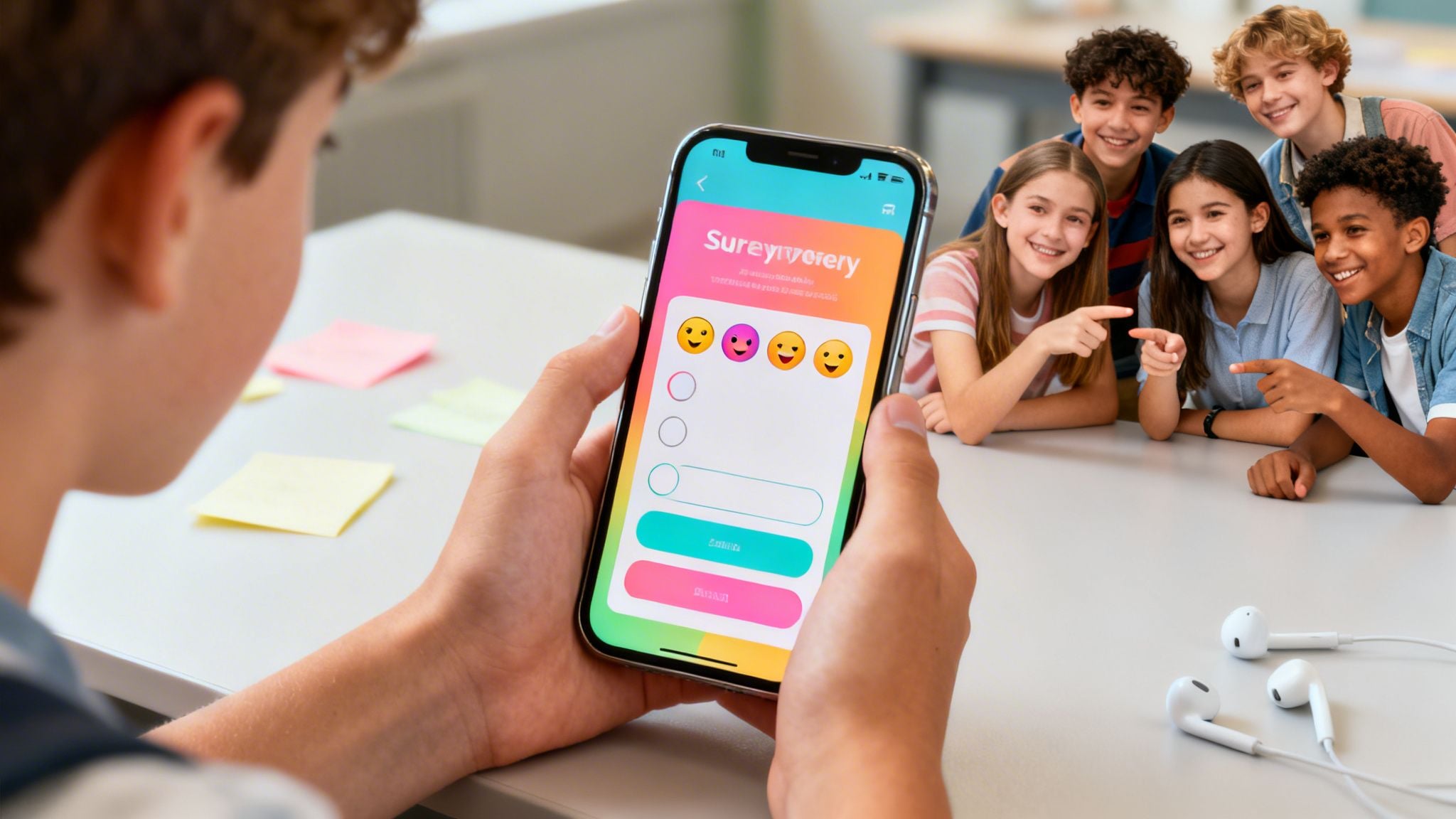
Forget everything you think you know about making a good survey. When you’re trying to get feedback from teenagers, you’re playing a whole new ballgame. We're talking short attention spans, phones-glued-to-hands, and a built-in radar for anything that feels fake. Your standard corporate survey won't just do poorly—it will crash and burn.
Why You Need a Different Playbook for Teen Surveys
To get honest answers from teens, you have to meet them where they are. They don't see an online form as a formal request for information; to them, it's just another piece of content in their feed. That means your survey has to feel more like a quick chat than an interrogation.
It needs to be visual, respectful of their time, and feel genuine. Not getting this right is the #1 reason so many research projects aimed at young people get ignored.
This isn't just about tweaking a few questions. You have to understand how they live online. A great starting point is to create buyer personas that actually work, but adapt them specifically for teen behaviors. This pushes you past tired stereotypes and helps you design something based on how they actually use their devices. An adult might put up with a clunky survey on a desktop, but a teen will swipe away without a second thought.
It’s a Mobile-First World
Teens live on their phones. Simple as that. If your survey isn't designed for a small screen from the ground up, you've already lost. And "mobile-optimized" means more than just making sure it doesn't look broken.
- Thumb-Friendly: Are the buttons and options big enough to tap easily without zooming?
- Vertical Flow: Does it scroll smoothly, like their Instagram or TikTok feed?
- Less Typing, More Tapping: Use multiple-choice, sliders, and rating scales. Avoid asking them to type out long answers unless it's absolutely necessary.
You're competing for their attention against a constant stream of notifications, messages, and viral videos. You only have a few seconds to make a good impression.
Where Teens Actually Spend Their Time Online
If you want to reach teens, you have to show up in their digital hangouts. A landmark 2025 survey from Pew Research Center confirmed what many of us suspected: YouTube is still king. A massive 95% of teenagers have used it.
What’s really telling is that 77% of them visit YouTube every single day, and 16% say they're on it "almost constantly." This just hammers home how central video content is to their daily lives. TikTok is also a major player with 63% usage, but YouTube’s reach is nearly universal. You can dig into the full report on teen social media habits right from the latest research from Pew.
This chart breaks down the daily usage across the top platforms:
As you can see, platforms like YouTube and TikTok command daily, high-frequency attention. Contrast that with something like Facebook, which barely registers for this age group in terms of daily use.
And while you're thinking about teen habits, if you're looking for other ways to navigate student life, check out guides on https://studentwowdeals.com/ for awesome money-saving tips.
Key Takeaway: Authenticity is everything. Teens can spot something that feels corporate, condescending, or fake from a mile away. Use natural language, be upfront about why you're asking for their time, and design an experience that shows you respect their intelligence.
Designing Questions That Teens Actually Answer
The heart of any survey that actually gets finished by a teenager isn’t the prize or the platform—it's the questions. If your questions are boring, confusing, or feel like a test from a teacher, you're going to get junk data. Or, more likely, no data at all. Writing for this audience is a real art, mixing clear communication with a solid grasp of their digital world.
Think of it less like a formal inquiry and more like sliding into their DMs. The language has to be conversational, direct, and feel authentic. Ditch the corporate jargon or academic-speak immediately; it’s a massive red flag that your survey is out of touch and not worth their time.
Speak Their Language (Without Trying Too Hard)
Let's be real: trying to use current slang is a minefield. It often backfires and makes you sound like a parent trying to be cool. It's just awkward. Instead, focus on being clear, casual, and straight to the point. The goal is to sound human, not like an algorithm wrote your questions.
This means using simple sentences and cutting the fluff. Remember, you're fighting for attention on a screen that’s buzzing with notifications from TikTok, Snapchat, and group chats. Every second you waste is a chance for them to bail.
These are the core digital habits you have to build your survey around.

Bottom line: your questions need to be instantly understandable, easy to answer on a phone, and feel genuine.
Choose Question Types That Keep Them Tapping
The format of your questions is just as important as the words you use. Big, empty text boxes are the fastest way to get someone to close the tab. Instead, lean into interactive and visual questions that are made for tapping on a mobile screen.
- Visual Rating Scales: Ditch the classic 1-to-5 number scale. Use stars, emojis (😠 to 😄), or other fun icons. It's way more intuitive and visually interesting.
- Image Choices: Ask them to pick their favorite from a set of images. This could be logos, product designs, or even app screenshots. It’s a great way to break up the monotony of text.
- Sliders: For anything about frequency or intensity (like, "How often do you use…?"), sliders are far more interactive than a boring multiple-choice list.
- Punchy Multiple-Choice: Keep your options short, sweet, and distinct. I always aim for 3-5 options max. If you absolutely need a longer list, use a dropdown menu to save screen real estate.
A great rule of thumb I always use is the "three-second test." Can someone look at the question, understand what you're asking, and see how to answer within three seconds? If not, rewrite it.
A simple rephrase can make a world of difference. Check out these before-and-after examples to see how you can transform a dry, clunky question into something a teen will actually answer.
Question Makeover for Teen Surveys
| Ineffective Question (Avoid) | Engaging Alternative (Use This) |
|---|---|
| On a scale of 1-10, how would you rate your overall satisfaction with the user interface? | How easy was it to use the app? (With an emoji scale: 🤯 😫 🤔 🙂 😎) |
| Please provide your feedback regarding the new features we have implemented. | What's your honest opinion on our new feature? (Open text, but optional) |
| How frequently do you utilize this application on a weekly basis? | How often do you open this app? (Options: A few times a day, Once a day, A few times a week, Rarely) |
| Which of the subsequent product attributes do you find most appealing? | Which of these features do you like most? (With icons next to each feature name) |
See the difference? The "Engaging Alternative" column uses simpler language, adds visual flair, and gets to the point quickly—all key for keeping a teen’s attention.
Avoid These Common Question-Writing Traps
Bad questions create bad data. It's that simple. Be on the lookout for these classic mistakes that will confuse your respondents and tank the quality of your feedback. The biggest offender I see is the double-barreled question, which sneakily asks two things at once.
For example: "Was the app easy to use and visually appealing?" That's a flawed question. What if it was super easy to use but looked terrible? The teen has no way to answer accurately, so they'll either guess or quit.
Here are a few other traps to spot and fix:
- Leading Questions: Phrasing a question to suggest a "right" answer. (e.g., "Don't you agree our new feature is amazing?"). This just gets you biased, useless results.
- Ambiguous Words: Terms like "often," "regularly," or "frequently" mean different things to different people. Be specific. Instead of "often," say "Once a day" or "2-3 times a week."
- Jargon or Assumed Knowledge: Never, ever assume your audience knows industry terms. Explain things simply or just avoid the jargon altogether. If you’re asking about a "UI Kit," you’ve already lost them.
Getting Consent, Privacy, and Ethics Right

When you’re creating an online survey for teenagers, things like privacy and ethics aren't just a "nice-to-have." They're completely non-negotiable. This isn't only about building trust; it's a matter of legal and moral responsibility. The rules can feel a bit tangled, but the main idea is simple: you have to protect your young participants.
The first hurdle is understanding consent, which changes with age. In most places, there's a hard legal line. In the United States, for instance, the Children's Online Privacy Protection Act (COPPA) is very clear: you need verifiable parental consent before collecting personal info from anyone under 13.
For older teens, the rules might be a little different. But honestly, even if it's not strictly required by law, getting a parent or guardian involved is always the smartest and most ethical move, especially if your survey digs into sensitive topics.
How to Get Parental Consent Without the Hassle
Asking for a parent's permission can feel like a huge roadblock, but it doesn't have to kill your response rate. The trick is making it incredibly easy. A clunky, multi-step process that involves printing, signing, and scanning is a surefire way to lose participants before they even start.
Here are a few digital-friendly ways to handle it:
- Use a Two-Part Digital Form: First, the teen shows they're interested. This automatically shoots an email to their parent with a simple consent form. The parent can just click a link, read the details, and give a digital signature or check a box. Easy.
- Create a "Parent's Corner": Set up a clear, easy-to-find section on your survey's landing page. This spot should explain what the survey is for, what data you're collecting, and how you'll use it—all in plain English.
- Make a Short Video: A quick, friendly video (under 60 seconds) can explain everything to both the teen and their parent. It's way more engaging than a block of text and helps build trust right off the bat.
Remember, the whole point is informed consent. Parents need to know exactly what they're agreeing to for their child.
Writing a Privacy Policy That People Actually Understand
Your privacy policy is basically a promise. A standard, jargon-packed legal document is pretty useless here. It needs to make sense to a 15-year-old and their parent at the same time. If you want to see a good example of clear, user-focused language, check out how we explain things in our own privacy policy at https://studentwowdeals.com/privacy-policy/.
Key Takeaway: Treat personal data like it's radioactive. Your policy must transparently answer three big questions: What are you collecting? Why are you collecting it? And who is going to see it?
As you map out your survey, it's crucial to think through all the ethical considerations, especially with a younger audience. A massive part of this is anonymizing your data. This means stripping out any personally identifiable information (PII)—like names, emails, or specific locations—from your final dataset. You need to assure participants that their individual answers will never be tied back to them.
Dealing with Sensitive Topics Responsibly
The digital world teenagers live in can be a minefield. Recent Microsoft research on global online safety painted a pretty stark picture, finding that 74% of teenagers ran into online risks like cyberbullying or hate speech in the last year. This makes them a vulnerable group, a fact you absolutely must respect.
If your survey touches on sensitive areas like mental health, social pressure, or online safety, your ethical duty gets even bigger.
- Always Offer an Opt-Out: Make it clear that sensitive questions are optional. Let participants skip anything that makes them uncomfortable without any penalty.
- Provide Resources: At the end of your survey, include links to support resources. This could be a mental health hotline, a cyberbullying support group, or other helpful organizations.
- Frame Questions Carefully: Watch out for triggering language. Instead of asking, "Have you ever been bullied online?" try framing it more gently, like, "Have you ever seen or experienced unkind behavior online?" This focuses on the action, not a heavy label.
Responsible research means putting the well-being of your participants above everything else. By navigating consent, privacy, and ethics with genuine care, you'll not only gather better data but also build a reputation for being trustworthy and respectful.
Choosing Your Channels and Incentives
A perfectly designed survey is useless if no one ever sees it. Simple as that. Once you've sorted out your questions and all the ethical stuff, your next big hurdle is getting that online survey for teenagers in front of actual teens. This means you've got to ditch old-school methods like email blasts and meet them where they actually hang out online.

Just slapping a link on your profile and hoping for the best is a sure-fire way to fail. You need a savvy distribution plan paired with an incentive that makes taking your survey feel like a good deal. It's a careful balancing act.
Finding Teens Where They Live Online
Forget mass emails. Seriously. To reach teenagers, you need to be on visual, fast-paced, social platforms. Your survey has to slide right into the feeds they're already scrolling through every single day.
- TikTok and Instagram: These are your go-to channels. Use short, attention-grabbing videos or slick graphics in your Stories to plug the survey. The "link in bio" is prime real estate, but the swipe-up "link sticker" in Stories is gold because it’s just so easy for them to use.
- YouTube: Got a bit of a budget? A pre-roll ad targeting specific channels or interests can work wonders. If you're looking for a more organic vibe, try teaming up with creators who already have a genuine connection with a teen audience.
- Online Communities: Niche communities on places like Reddit (think r/teenagers) or specific Discord servers can be absolute goldmines. But, and this is a big but, always read the rules first. Many groups have zero tolerance for self-promotion, so you might need to get a mod's blessing before you post.
It's no secret that teens are glued to their phones. A 2025 WHO/HBSC report highlighted a worrying trend, with problematic social media use projected to jump from 7% in 2022 to 11% by 2026. The report also found 36% of teens are in constant online contact with friends, which shows just how central these platforms are to their social lives. You can dive deeper by reviewing the full findings on adolescent digital behaviors.
Crafting an Incentive That Actually Works
For a teenager, time is everything. To get them to give you some of theirs, you need to offer something they genuinely want in return. The reward has to match the effort.
Key Takeaway: The incentive isn't just a bribe; it's a way of saying you respect their time. A lame or irrelevant reward can feel more insulting than offering nothing at all.
What gets one teen excited might not work for another, but some rewards are pretty consistent winners. A small, guaranteed reward often works better than a big lottery-style prize because it’s a sure thing. Instant gratification rules.
Here’s a quick rundown of what works and when:
| Incentive Type | Best For | Why It Works | Potential Downside |
|---|---|---|---|
| Instant Digital Gift Card | Longer surveys (10-15 min) | It’s immediate, real value. Teens can use it for brands they actually care about, like Uber Eats, Amazon, or Steam. | Can get pricey if you're aiming for a lot of responses. You need a system to send them out instantly. |
| Prize Draw Entry | Shorter surveys (under 5 min) | A cheap way to pull in big numbers. The chance to win something big (like a PS5 or a new phone) is always tempting. | Doesn't feel as valuable to each person. Some won't bother for just a slim chance of winning. |
| Exclusive Content/Discount | Brand-specific surveys | A great move if your brand is already a hit with teens. You're offering them something they can't get anywhere else. | Only really works if your brand already has some street cred. Not very motivating for general research. |
For many students, every dollar counts, which is why apps offering exclusive savings are so popular. If you're trying to figure out what kind of value to offer, it's worth learning more about the Student Wow Deals app to see what discounts get their attention.
The Psychology of Teen Motivation
At the end of the day, the best incentive feels like a fair trade. For a quick 3-minute survey, dangling a chance to win a $100 gift card might be all you need. But if you’re asking for 15 minutes of thoughtful answers, a guaranteed $5 or $10 digital gift card is way more appropriate.
Think about your brand's world. If you're a food delivery service, an Uber Eats or DoorDash credit is a no-brainer. In the gaming world? A Steam or Roblox gift card will hit the mark. The more relevant the reward, the more it will connect. Get this part right, and you're well on your way to getting great data from your online survey for teenagers.
You’ve designed your questions, sorted the ethics, and dangled the perfect incentive. Awesome. But hold on—don't hit that "launch" button just yet. Before you send your survey out into the wild, there's one last, make-or-break step: the pilot test.
Skipping this is like trying to bake a cake without preheating the oven. You might end up with something, but it definitely won’t be what you were hoping for.
A pilot test is your secret weapon. Think of it as a small-scale dress rehearsal where you can catch all the awkward phrasing, confusing questions, and tech glitches that could totally mess up your data. You don’t need a huge group for this, either. Just a handful of 5-10 teens from your target audience is perfect.
Running an Effective Pilot Test
The whole point here is to get brutally honest feedback. Don't just flick them the link and ask if it was "good." You need to watch, ask sharp questions, and be ready to hear that one of your favorite questions is actually terrible.
It’s basically a usability test for your survey. You could even ask a couple of them to share their screen while they take it, talking you through their thought process as they go. This is hands-down the best way to see where they hesitate, get stuck, or what makes them roll their eyes.
Here’s a practical checklist of what to watch for:
- Clarity and Flow: Are any questions confusing? Did they have to re-read anything? Watch for those little pauses—they mean something.
- Technical Glitches: Does every button work? How does it look on different phone models? Are the images loading properly?
- Estimated Time: Actually time them! Does your "5-minute" survey really take 12 minutes? Be honest about the time commitment on your intro page.
- Question Quality: Are you getting the kind of answers you need? Are they just flying through certain sections without thinking?
Pro Tip: After they finish, ask one simple question: "If your friend sent you this, would you actually complete it? Why or why not?" Their answer will tell you everything you need to know about how engaging your survey really is.
Once you have this feedback, go and make the changes. This isn't about ego; it’s about making your online survey for teenagers as effective as it can be. A solid pilot test is the difference between getting clean, insightful data and a pile of messy, unreliable responses.
Turning Raw Numbers Into a Compelling Story
Alright, your survey is live and the responses are pouring in. Now the real fun begins. It's time to turn all that raw data into something that actually makes sense. You don’t need a Ph.D. in statistics for this; most modern survey platforms like SurveyMonkey or Typeform have built-in tools that make basic analysis pretty straightforward.
The very first thing you need to do is data cleaning. This just means filtering out the junk. Look for incomplete responses, answers from people outside your target age range, or "speeders"—those who obviously just clicked through as fast as possible to get the incentive. Getting rid of these ensures your insights are built on a solid foundation of quality data.
Next, start looking for the big picture. What are the most common answers? These top-level findings are your headline. For instance, maybe you discover that 75% of respondents said they prefer watching short-form video over long-form content. That’s a powerful, clear insight right off the bat.
Segmenting Your Data for Deeper Insights
The real magic happens when you start segmenting your data. This is just a fancy way of saying you break down your results by different groups to see how their answers compare. It’s how you uncover the why behind the what.
Here are a few common ways to slice and dice your teen survey data:
- By Age Group: How do the opinions of 13-14 year-olds differ from 16-17 year-olds? Trust me, their priorities and habits can be worlds apart.
- By Gender: Are there noticeable differences in preferences or behaviors between boys, girls, and non-binary respondents?
- By Platform Usage: How do the answers of daily TikTok users compare to those who mainly use YouTube? This helps you connect behaviors to attitudes.
For example, you might find that while your new feature is generally well-liked, it’s overwhelmingly popular with older teen girls who use Instagram every day. That’s not just data; that’s an actionable insight you can use to tailor your next marketing campaign.
Visualizing this with simple bar charts or pie graphs makes these patterns pop, helping you tell a clear and compelling story with your findings.
Even with a killer plan, putting together an online survey for teenagers can feel like you're trying to solve a Rubik's Cube in the dark. It's totally normal to have a bunch of questions pop up along the way.
Think of this section as your quick-fire guide for those "am I messing this up?" moments. We’ll get straight to the point on everything from how long your survey should be to the best spots to actually find teens online.
What's the Ideal Length for a Survey Aimed at Teens?
Short. Super short. The magic number is somewhere between 5-10 minutes.
The second your survey starts to feel like homework, you'll see your completion rates fall off a cliff. Pushing past 10 minutes is a risky move unless you've got a seriously tempting incentive on the table. A good rule of thumb? Aim for a maximum of 15-20 questions. It forces you to be ruthless and only ask what's absolutely essential.
If you really can't cut it down, you've got a couple of options:
- Just Be Honest: If your survey is going to take 15 minutes, tell them that right from the start. Nobody likes being told something will be quick only for it to drag on. Managing expectations builds trust.
- Up the Reward: A quick 3-minute survey might get away with a prize draw entry. But if you're asking for 15 minutes of their time, you probably need to offer a guaranteed reward, like a $5-$10 gift card, to show you genuinely respect their effort.
How Can I Get Real Answers and Not Just Rushed Clicks?
Getting genuine, thoughtful feedback from teens all comes down to trust and smart survey design. If you want authenticity from them, you have to give it first.
Start by making sure your survey is built for a phone. It needs to feel natural, with conversational language—not stiff, corporate speak. Think less "formal examination," more "quick chat."
Next, sneak in an "attention check" question. This is just a simple instruction disguised as a multiple-choice question. Something like, "To show you're paying attention, please select 'Agree' for this question." It’s a surprisingly effective way to weed out bots and people mindlessly clicking through.
Here's a pro tip: Include one or two optional open-ended questions. The effort a teen puts into answering those—or if they even bother—is a huge clue as to how engaged they really are with your survey.
Finally, a fair incentive does more than just get you responses; it sends a message. It says, "I value your honest opinion," which naturally encourages more thoughtful and authentic answers.
What Are the Biggest Mistakes People Make When Surveying Teens?
So many well-meaning surveys flop because of a few common, and totally avoidable, blunders. Just knowing what they are is half the battle.
From my experience, these are the top three mistakes I see again and again:
- Using a Generic Adult Template: This is a classic. A survey clearly designed for a desktop with tiny fonts and formal language is an instant turn-off on mobile. It screams "I don't get you," and your response rates will pay the price.
- Messing Up on Ethics and Privacy: This isn't just a small mistake; it's a massive legal and trust-killer. Failing to get parental consent where it’s legally required or being fuzzy about how you'll use their data will completely tank your project's credibility.
- Asking Biased or Leading Questions: Your job is to find out what they think, not to get them to agree with you. A question like, "Don't you agree our new feature is so much better?" is just fishing for compliments and gives you useless data.
Seriously, always pilot test your survey with a handful of actual teens. They'll spot these problems in about five seconds.
Where Are the Best Places Online to Find Teenagers for My Survey?
To find teens, you have to go where they are. Simple as that. Don't waste your time expecting them to magically find you. This means showing up on the platforms that are already glued to their hands.
Your go-to channels should be TikTok, Instagram, and YouTube. Study after study confirms this is where they spend their time. For instance, a staggering 90% of U.S. teens use YouTube, with 73% on it daily. TikTok isn't far behind, with 63% usage. You can tap into this through targeted ads or, for a more organic vibe, by collaborating with influencers who already have a genuine connection with your target audience.
But don't just stop at the big social apps. Niche online communities can be goldmines.
- Reddit: Subreddits like
r/teenagersare huge and incredibly active. Just make sure you read and follow their community rules about self-promotion before you even think about posting a link. - Discord: Lots of teens are part of interest-based Discord servers. If your survey is about something specific like gaming, anime, or art, these servers are perfect for finding a super-engaged audience.
If you're doing more formal academic or market research, another solid route is to partner with student-focused organizations or get official permission to work directly with schools and youth groups.
Ready to connect with a verified student audience for your next project or promotion? Student Wow Deals gives you access to a community of over 400,000 students looking for great offers and opportunities. Learn more and get started.