



An Interrail pass is basically your single golden ticket to Europe's massive train network, linking up 33 different countries. Think of it as a flexible, all-access key that saves you from the headache of buying dozens of separate train tickets for your big trip.
So, How Does This Interrail Pass Actually Work?
Picture this: you're at a massive festival with stages spread out across an entire continent. Instead of buying a new ticket for every band you want to see, you've got one wristband that lets you go wherever you want, whenever you feel like it. That's exactly how the Interrail pass works for Europe's trains. It turns a potential logistical nightmare into a proper adventure.
This one pass gets you onto most national railways, from the slick high-speed trains connecting Paris and Amsterdam to the ridiculously scenic routes that snake through the Swiss Alps. Instead of juggling a dozen different booking websites and currencies for each leg of your journey, you just have one pass that makes life simple.
Getting Your Head Around "Travel Days"
The most important thing to understand is the "travel day." This is the secret sauce that makes the pass so flexible.
A travel day is a 24-hour window, from midnight to midnight, where you can take as many trains as you want. You just activate a travel day on your pass for that date, and you’re free to hop on and off until the clock strikes twelve.
This system is an absolute game-changer for students who want to be spontaneous. Fell in love with a city and want to stay an extra day? No worries. You just don’t use a travel day. Need to cover a huge distance with a few changes? That's fine, it all counts as just one travel day.
Flexi vs. Continuous Passes: What's the Vibe?
Your choice of pass really comes down to your travel style. The two main types are built for completely different kinds of trips.
- Flexi Pass: This is the go-to for most students. It gives you a certain number of travel days to use within a bigger timeframe (like 7 travel days within 1 month). It's perfect if you plan on spending a few days exploring each city before moving on, since you only use a travel day when you're actually on a train.
- Continuous Pass: This one's for the hardcore travellers. It gives you unlimited train travel for a set number of days in a row (e.g., 15 days, 1 month, or 2 months). It’s designed for those whirlwind tours where you’re on the move almost every single day, trying to see as much as possible in a short amount of time.
At the end of the day, an Interrail pass is all about freedom. It’s an invitation to embrace the unexpected, change your plans on a whim, and stumble upon those hidden gems you’d otherwise miss. It's not just a ticket; it’s your license to make Europe your own.
Choosing the Right Interrail Pass for Your Trip
Picking the perfect interrailing pass europe can feel like a huge decision, but it really just comes down to two questions: where are you going, and for how long? Your answers will point you straight to the best pass for your adventure, making sure you get maximum value without paying for travel days you don't need.
First up, where do you want to play? Are you dreaming of an epic cross-continent trip, hopping from the canals of Amsterdam to the coast of Croatia? Or would you rather dive deep into one country, exploring every corner of Italy from Milan to Sicily?
- The Global Pass is your golden ticket to 33 countries. This is the classic choice for students who want to see as much of Europe as they can cram in.
- The One Country Pass is for an in-depth exploration of a single nation. It’s perfect if you want to properly soak up Spanish culture or hike through every region of Switzerland.
Flexi or Continuous? What’s Your Travel Style?
Once you've figured out the "where," the next choice is all about your travel rhythm. Are you a whirlwind explorer, constantly on the move? Or do you prefer a more chilled pace, with longer stops to really get to know each city? This is where you decide between a Flexi Pass and a Continuous Pass.
A Flexi Pass gives you a set number of travel days to use within a bigger timeframe, like ‘7 travel days in 1 month’. Honestly, this is the best fit for most students. It means you can spend a few days exploring a city without "wasting" a travel day—you only use one when you actually get on a train to the next stop.
On the other hand, a Continuous Pass offers unlimited train travel for a solid block of time, like 15 days straight or a full month. This pass is built for those fast-paced, non-stop itineraries where you’re on a train almost every single day.
This decision tree breaks it down based on your travel vibe—spontaneous or structured.
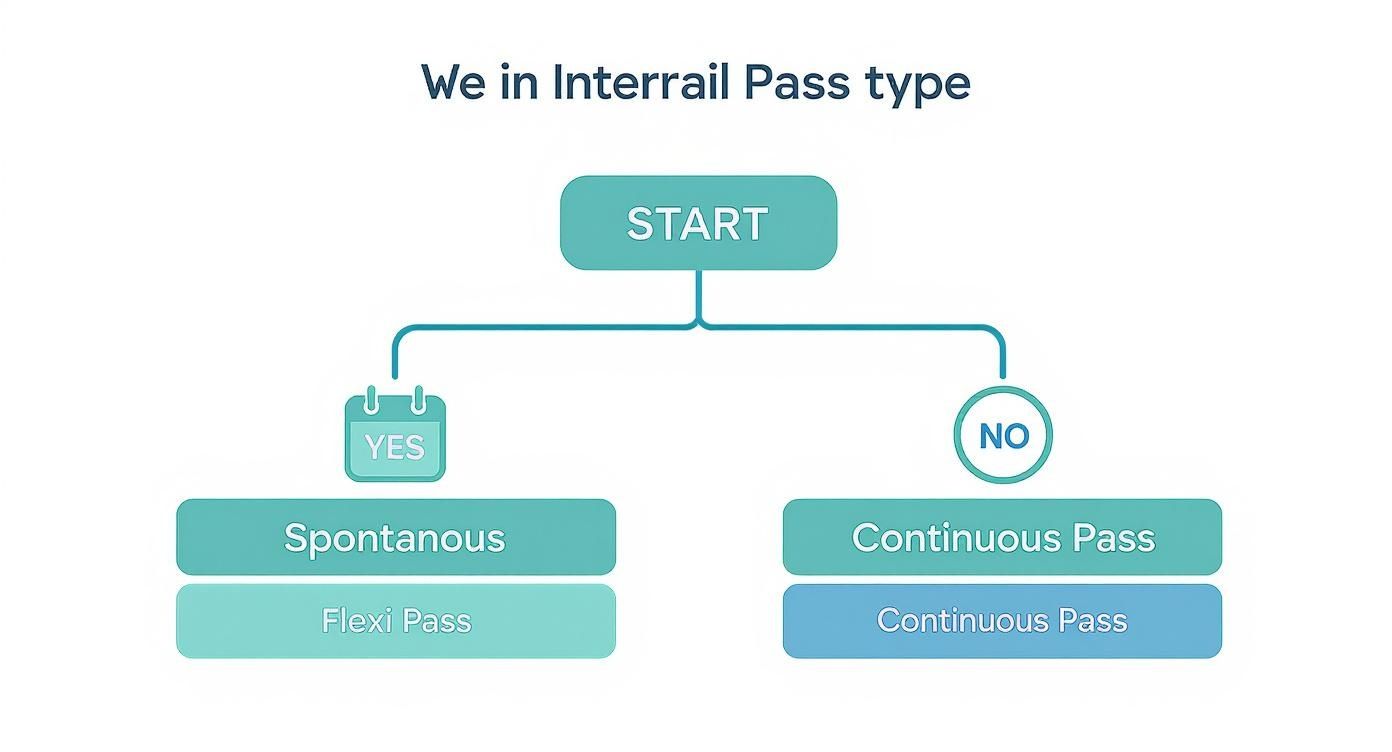
As you can see, if your trip involves chilling in each city for a while (spontaneous), a Flexi Pass saves you money. If your schedule is jam-packed with daily train journeys (structured), the Continuous Pass is the better deal.
To make it even clearer, let's compare the most popular Global Pass options.
Interrail Global Pass Options Compared
Here’s a quick look at the top Flexi and Continuous passes to help you see which one lines up with your travel plans.
| Pass Type (Flexi) | Best For | Example Itinerary | Pass Type (Continuous) | Best For |
|---|---|---|---|---|
| 7 days in 1 month | Shorter trips or deep dives into a few regions. Great for a 2-3 week holiday. | A week-long sprint through Benelux (Brussels, Amsterdam, Luxembourg) with a few days in each city. | 15 consecutive days | A non-stop, fast-paced tour covering a lot of ground in a short time. |
| 10 days in 2 months | The classic student choice for a month-long trip with longer city stays. | A month-long trip visiting 5-6 major cities like Paris, Barcelona, Rome, Vienna, and Berlin, spending 4-5 days in each. | 22 consecutive days | An intense three-week trip where you're moving to a new city every 1-2 days. |
| 15 days in 2 months | The ultimate freedom for a 6-8 week summer adventure across multiple countries. | A two-month grand tour from Lisbon to Istanbul, stopping at both major hubs and smaller towns along the way. | 1, 2, or 3 months | The marathon pass for gap year students or anyone planning to live on the rails for an entire season. |
Ultimately, the Flexi passes offer the best balance of freedom and value for most student trips, letting you explore without feeling rushed.
Understanding Interrail vs. Eurail
One thing that trips everyone up is the difference between Interrail and Eurail passes. They’re basically the same thing, but who can buy them depends on where you live.
Interrail Passes are for European citizens and official residents of a European country. Eurail Passes are for non-European citizens and residents (like students from the US, Canada, or Australia). They work exactly the same, just with a different name.
This is super important when you're buying, as you’ll need to show proof of residence. Make sure you get the right one to avoid any headaches when you start your trip.
Maximising Youth Discounts and Opportunities
For students and young travellers, the interrailing pass europe is an absolute bargain. If you are 27 years old or younger, you get a massive youth discount that can knock up to 25% off the price of a pass. This makes an already amazing deal even sweeter for anyone on a student budget.
Rail travel is so valued for young people that some even get to go for free. The EU’s DiscoverEU initiative handed out 35,762 free travel passes in 2024-2025 to 18-year-old Europeans. This gives them up to 30 days to explore, promoting cultural exchange and sustainable travel.
Choosing the right pass is your first big win in planning the trip of a lifetime. By matching your travel style to the pass type—Global or One Country, Flexi or Continuous—you’re setting yourself up for a smooth, budget-friendly adventure through Europe.
Mastering Seat Reservations and Night Trains
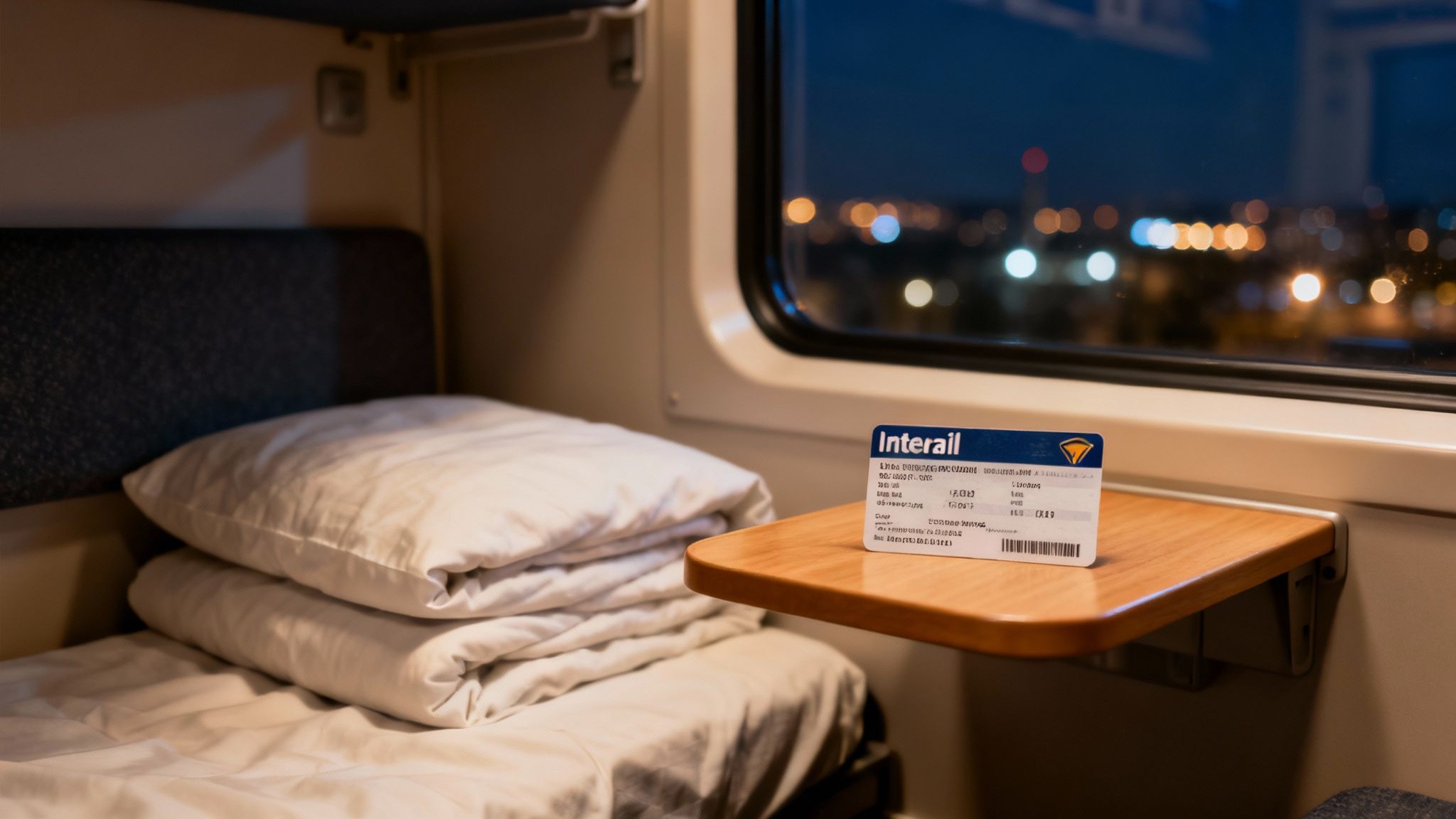
Alright, let's talk about one of the biggest learning curves for first-time Interrailers: the seat reservation system. It’s a classic rookie mistake to assume your interrailing pass europe guarantees you a spot on every single train.
Think of your pass as your ticket to a massive music festival. It gets you through the gates, but for the most popular headliners, you need a separate ticket to get into the front section. That's exactly how seat reservations work.
This is especially true for high-speed trains, international routes, and literally all overnight services. These popular trains require a mandatory seat reservation, which is a separate booking you make for a small fee. It locks in your spot and helps the train companies manage their busiest routes. If you don't book one, you could be hit with a hefty fine or even asked to get off at the next station. No thanks.
When Are Reservations Required?
Figuring out the rules can feel a bit much at first, but it really just boils down to the country and the type of train. Some countries are super chill with a "hop-on, hop-off" vibe, while others are much stricter, requiring a booking for nearly every long-distance train. Getting your head around this is the key to a stress-free trip.
Here's a quick cheat sheet to get you started:
- Countries Where You'll Book a Lot: France, Spain, and Italy are the big ones. For high-speed services like the TGV in France or the Frecciarossa in Italy, reservations are almost always a must. They can also sell out weeks ahead, especially in summer, so get in early!
- Countries with More Flexibility: Germany, Switzerland, Austria, and the Benelux countries (Belgium, Netherlands, Luxembourg) are a dream for spontaneous travellers. On most of their domestic trains, including Germany's slick ICE trains, reservations are optional. You just find an empty seat and make yourself at home.
Pro Tip: Even where reservations are optional, it's worth spending a few euros to book a seat during peak times, like a Friday afternoon or a public holiday. Trust me, it beats standing for a three-hour journey.
The Rail Planner app is your best mate for this. It clearly shows which trains need a mandatory reservation, so you can avoid any awkward surprises at the station.
The Magic of Night Trains
Honestly, night trains are the ultimate Interrail hack, especially if you're a student on a budget. They’re not just a way to get from A to B; they’re a hotel on wheels that saves you serious time and cash.
Instead of losing a precious day to travel, you hop on in the evening, fall asleep, and wake up hundreds of kilometres away in a brand-new city, ready to explore. You’ve basically combined your transport and accommodation costs into one neat package. Better yet, on a Flexi Pass, an overnight journey only uses up one travel day—the day you depart. It's the most efficient way to cover those long-haul routes.
Couchettes vs Sleepers
When you go to book a night train, you’ll usually see two main options: couchettes and sleepers.
- Couchettes: This is your standard, budget-friendly choice. You'll be in a shared compartment with four to six other travellers, sleeping in simple bunks with a pillow, blanket, and sheet. It’s social, cheap, and a classic backpacker experience.
- Sleepers: A step up in comfort and privacy. You get a proper bed in a compartment for one, two, or three people. They often come with a washbasin, and sometimes even a private toilet and shower, for more of a hotel room feel.
Whichever you pick, you're unlocking one of the most memorable experiences an interrailing pass europe can offer.
While some countries are super flexible, it’s always smart to look into local deals. For example, if you're planning a deep dive into Germany, you can often score great value with specific student train tickets for DB. Once you master reservations and the art of the night train, your trip will be smoother, cheaper, and a whole lot more adventurous.
How to Plan Your Perfect Interrail Route
Okay, this is where the magic really begins. With your pass in hand, the entire continent is basically your playground. But… where do you actually start? The secret to an incredible trip isn't just picking cool cities; it's about stringing them together so it feels like a proper adventure, not a frantic marathon.
A great Interrail route should tell a story. It needs to flow logically from one spot to the next, which saves you from soul-crushing travel days and backtracking. Instead of zig-zagging across the map like a confused fly, think of it as a natural journey with a clear beginning, middle, and end.
You want to spend your time exploring, not just sitting on a train to retrace your steps. A smart route means more fun, less travel fatigue, and making every moment count.
Finding Your Vibe: Three Ways to Get Inspired
To get the ideas flowing, let's look at three classic, field-tested itineraries. Think of these less as strict rules and more as springboards for your own grand tour. Each one offers a totally different vibe, from sun-drenched coastlines to historic cityscapes.
1. The Mediterranean Sun Chaser
- The Vibe: Pizza, pasta, and pure coastal bliss. This one is all about soaking up the sun, wandering through ancient ruins, and diving into the laid-back life of Southern Europe.
- The Path: Kick things off in Rome, then wind your way up through Florence and the ridiculously beautiful Cinque Terre. From there, hop a train along the French Riviera to Nice and Marseille, before crossing the border into Spain for the non-stop energy of Barcelona.
- The Experience: You’ll be tasting real-deal gelato in Italy, hiking between colourful cliffside villages, and finishing up with tapas on a bustling Spanish plaza. It's basically a trip fuelled by sunshine and unbelievable food.
2. The Central European Classic
- The Vibe: Grand buildings, mind-blowing history, and seriously good value for money. This route takes you through the heart of the old Austro-Hungarian Empire, where majestic cities are packed close together and your student budget will stretch for miles.
- The Path: Start in the fairy-tale city of Prague, then head south to the imperial grandeur of Vienna. Next up, it's a short and scenic ride to the buzzing Hungarian capital, Budapest, famous for its ruin bars and thermal baths.
- The Experience: This is a trip through time, from medieval castles to over-the-top palaces. You'll be exploring centuries of history while living it up in some of the most affordable and fun cities Europe has to offer.
3. The Balkan Explorer
- The Vibe: Off-the-beaten-path adventure and scenery that will blow your mind. This is for anyone who wants to ditch the main tourist trail and discover the rugged, beautiful landscapes of Southeast Europe.
- The Path: Begin in Ljubljana, Slovenia’s ridiculously charming capital, before making a beeline for the stunning views at Lake Bled. Then, travel down the Croatian coast, hitting up Zagreb and the coastal gem of Split.
- The Experience: Get ready for emerald-green rivers, dramatic coastlines, and a fascinating mix of cultures. It's a route for the adventurer at heart, offering insane scenery without the insane crowds.
Using Tech to Build Your Master Plan
Once you’ve got a rough idea simmering, it’s time to make it a reality. Your best friend for this is the official Rail Planner app. Seriously, think of it as your mission control for the whole trip.
The Rail Planner app is so much more than a timetable. It’s an interactive map that lets you plot journeys, check connection times, see which trains need reservations, and save your entire itinerary in one spot. Best of all? It works offline, which is a total lifesaver when you’re on a train with Wi-Fi that’s… let's just say, "unreliable."
Using it is dead simple. Just plug in your start and end points for a leg of the journey, and it’ll spit out all the possible connections. This lets you play around with different options until you’ve built a route that makes sense and fits your pace. And the scale of this network is massive. In 2024, Interrail travellers hopped on over 5.9 million trains, covering a mind-boggling 1.4 billion kilometers across 33 countries. You can see more wild stats about European rail travel on Interrail.eu.
By saving potential journeys in the app's "My Trip" feature, you can stitch together your dream route, piece by piece. It gives you a visual plan, helps you spot any clunky backtracking, and ensures your adventure flows as smoothly as possible. This is how you turn a list of cities into a truly unforgettable journey.
Interrailling on a Budget Without Missing Out
An epic European adventure on an Interrail pass doesn't mean you have to empty your bank account. Not even close. With a bit of smart planning, you can have the trip of a lifetime without the financial hangover. The real trick is to map out a realistic daily budget and then stick to it with a few clever hacks.
Think of your budget as the financial backbone of your trip—getting it right is everything. It’s easiest to break it down into four main chunks: accommodation, food, activities, and those sneaky extra costs like seat reservations.
Building Your Daily Student Budget
For a student Interrailing trip, a daily budget of around €50-€70 is a great starting point. This is a comfortable but sensible range that covers your essentials while still leaving a little room for fun.
Of course, this will swing depending on where you are. In cheaper cities like Prague or Budapest, you might get by on just €40, while in pricier spots like Paris or Amsterdam, you’ll probably lean closer to €80.
Here’s a rough idea of how that daily budget breaks down:
- Accommodation (€20-€35): Hostels are your new best friend. Seriously. A dorm bed is affordable, it's an incredible way to meet other travellers, and you'll often score a free breakfast.
- Food (€15-€20): This is where you can make the biggest savings. Think supermarket picnics for lunch and cooking up a simple pasta dinner at the hostel. It keeps costs way down.
- Activities (€10-€15): Hunt down the free walking tours and always flash your student ID at museums for a discount. Most cities are packed with incredible parks, viewpoints, and neighbourhoods that don't cost a thing to explore.
- Extras (€5-€10): This little buffer covers things like your daily metro pass, a mandatory seat reservation every few days, or a well-deserved gelato.
To stay on top of it, track your spending with an app like Splitwise or even just a simple notebook. You'll see exactly where your money is going and can adjust on the fly.
Money-Saving Hacks for Smart Travellers
Beyond just watching your daily spend, there are some brilliant strategies to make your money go further. These tips can add up to huge savings over your trip, meaning you can travel for longer or splash out on that one bucket-list experience.
One of the best hacks is to embrace the shoulder seasons. Travelling in May, June, or September instead of the peak months of July and August can slash your costs. You'll find cheaper hostels, smaller crowds, and much nicer weather for exploring.
Your Interrail pass itself is a goldmine of hidden discounts. It often gives you reduced fares on ferries, city cards, and even entry to certain museums. Always check the "Pass Benefits" section in the Rail Planner app before you pay for anything.
Avoiding Common Money Traps
Finally, being a savvy traveller means knowing how to dodge the common financial pitfalls that catch out so many first-timers. A few simple precautions will protect your budget from unnecessary fees and keep your money where it belongs—in your pocket.
When you need cash, always use an ATM attached to a real bank and always decline the machine's offer to convert the currency for you. Let your own bank handle the exchange rate; it'll be much better.
Also, remember that the train isn't always the cheapest way to get from A to B. For shorter, direct city-to-city journeys, it's worth checking out affordable coach services. You can often find a great Flixbus student discount that might save you a travel day on your pass for a longer, more scenic journey later on.
Your Essential Packing and Safety Checklist
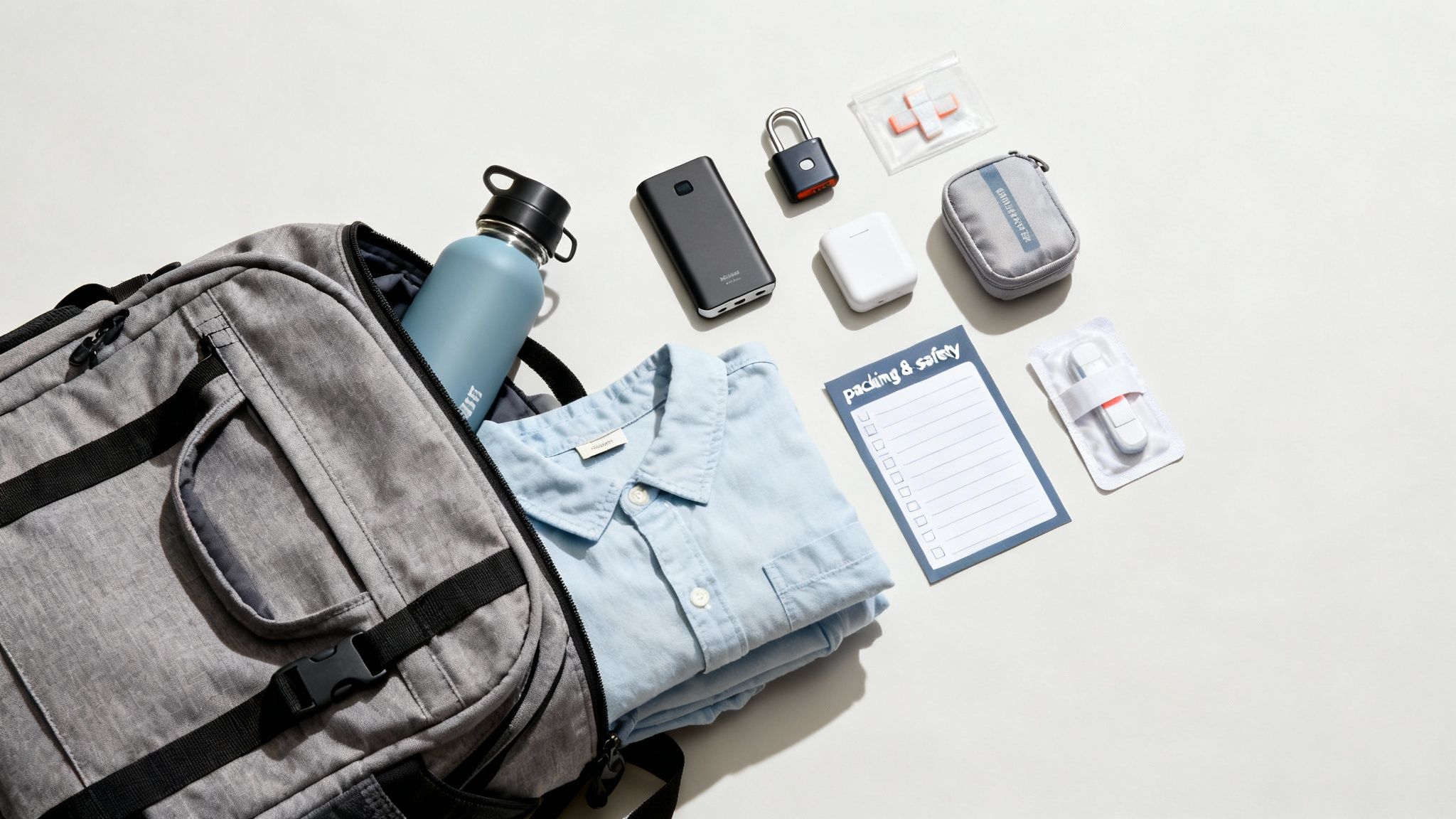
A little smart prep is all it takes to turn potential travel stress into pure adventure. Honestly, the real secret to enjoying your interrailing pass europe trip is mastering the art of packing light.
Live by the "one backpack" philosophy. My rule of thumb? If you can’t comfortably carry it up a few flights of stairs, you’ve packed way too much. This approach means no checked bag fees, no struggling through crowded stations, and total freedom to be spontaneous. Think minimalist, think versatile.
Packing The Essentials
Your backpack is basically your home on the road, so every single item has to earn its spot. Focus on stuff that pulls double duty and keeps you comfy while you’re on the move.
- Versatile Clothing: Pack layers you can easily mix and match. A few t-shirts, one solid pair of jeans or trousers, a jumper, and a waterproof jacket will get you through almost anything.
- Reusable Water Bottle: Staying hydrated is a must, and buying plastic bottles every day is a waste of money and terrible for the planet. Most European cities have perfectly safe tap water.
- Portable Power Bank: This is a total non-negotiable. It’ll keep your phone juiced up for tickets, maps, and photos on those long travel days.
- Simple Travel Lock: A small padlock is a lifesaver for securing your bag in hostel lockers and gives you some extra peace of mind on packed trains.
Staying Safe On The Road
Staying safe is less about being paranoid and more about just being aware of what’s going on around you. Europe saw a massive surge in Interrail pass sales in 2023 as travellers jumped back on the sustainable train travel trend, with passenger numbers even beating pre-pandemic levels. More people means it pays to be prepared.
On busy trains, always keep your backpack where you can see it—the rack above your seat is usually your best bet. If you’re on a night train, use your pack as a pillow or use your travel lock to secure it to the luggage rack.
The Golden Rule: Never leave your valuables unattended, not even for a second. This one simple habit stops the vast majority of opportunistic thefts before they can happen.
In big tourist spots, just be wary of common scams, like overly friendly people offering "help" with your bags or asking you to sign petitions. A polite but firm "no, thank you" is usually all you need to say.
Beyond your physical safety, it's also a good idea to secure your online activities, especially on public Wi-Fi networks, which you'll find everywhere from train stations to hostels.
Finally, the single most important safety net you can have is travel insurance. It’s the backup plan for everything from a lost passport to a random medical issue. Seriously, don't leave home without it. You can check out some great student-friendly options and learn more about travel insurance for your trip. It's a small investment that gives you the confidence to handle whatever comes your way, letting you just focus on the adventure.
Got Questions About the Interrail Pass? Let's Clear a Few Things Up
Even the most organised traveller has those last-minute, nagging questions. It’s totally normal. So, let's tackle the most common ones we hear from students about the interrailing pass europe, so you can get back to planning the fun stuff.
Is an Interrail Pass Actually Worth the Money?
Honestly, for most multi-city trips, the answer is a massive yes. If you’re planning on hitting several destinations with long-distance train journeys, the pass nearly always works out cheaper and way more flexible than buying individual tickets as you go.
Here's the acid test: sketch out your absolute must-do routes and quickly check the price for each one on a booking site. If the total is already creeping up near the pass price, just get the pass. It’s the smarter move, especially when you factor in the freedom to take a spontaneous detour whenever you feel like it.
Can I Use the Pass in My Own Country?
Yes, but there's a catch. Your Global Pass includes one outbound journey to get you out of your home country and one inbound journey to get you back home at the end. That’s it. You can use these two trips on any of your official travel days.
The whole point of the pass is to get you exploring internationally, not for zipping around your own backyard. Speaking of exploring, staying safe is just as important as having fun. If you're looking for practical advice, especially from a female perspective, you can find loads of in-depth female travel safety tips and real-world stories from experienced travellers.
Uh Oh, What Happens if I Miss My Reserved Train?
Okay, deep breath. If you miss a train that needed a mandatory seat reservation, you will unfortunately lose the money you paid for that specific reservation. The good news? Your Interrail Pass itself is still perfectly fine and valid.
You’ll just have to buy a new seat reservation for the next train heading your way. You can usually do this pretty quickly at the station's ticket office or sometimes right there in the Rail Planner app. To avoid this headache altogether, always give yourself plenty of buffer time for connections, especially in big, confusing train stations.
Find the best deals and unlock exclusive student discounts for your entire trip with Student Wow Deals. Start saving at https://studentwowdeals.com.