



Alright, let's get this sorted. Trying to figure out the energy market as a student can feel like you're attempting to read a different language. But honestly, your utility bill is one of the few big expenses you can actually wrestle down. We'll show you how to find the cheapest energy supplier for your shared house without getting bogged down in jargon.
Your Guide to Lowering Student Energy Bills

Think of this as your playbook for slicing those bills and freeing up cash for what really matters (like, you know, not living off instant noodles). We’ll walk you through everything, from decoding your first energy statement and using comparison tools like a pro, to timing your switch perfectly to dodge any pesky exit fees.
The first step to saving some serious cash is getting your head around the different types of energy plans, or 'tariffs', out there. Each one works differently, and picking the right one for your student house is a game-changer.
Common Energy Tariffs at a Glance
Here’s a quick breakdown of the most common energy plans you'll see and what they mean for your student budget.
| Tariff Type | How It Works | Best For Students Who… |
|---|---|---|
| Fixed-Rate Tariff | Locks in your price per unit of energy for a set period, usually 12 or 24 months. Your bill still changes with how much you use, but the rate itself is stable. | Prefer predictable costs and want to be safe from sudden price hikes. It’s a lifesaver for budgeting. |
| Variable-Rate Tariff | The price you pay per unit of energy can go up or down depending on the wholesale market. It’s flexible but definitely less predictable. | Are happy to keep an eye on the market and can handle a bit of fluctuation. It can be cheaper if market prices drop. |
| Green Tariff | The supplier promises to match some or all of your energy use by buying renewable energy. These can come in fixed or variable flavours. | Want to lower their carbon footprint. The prices are often pretty competitive with standard tariffs these days. |
The main thing to remember is that a cheap deal isn't just about the first price you see. It's about finding a tariff that actually fits how you and your housemates live.
The key to finding the cheapest energy supplier isn't just about the headline price. It's about matching a tariff type to your household's usage patterns and your tolerance for risk. A fixed tariff offers peace of mind, which is often invaluable when managing a tight student budget.
Switching suppliers is a huge win, but there are also loads of day-to-day habits you can build to lower your electric bill.
Of course, managing your energy is just one piece of the puzzle. Making smart choices about where you live is just as important. For more on that, check out our guide to student accommodation.
How to Read Your Current Energy Bill
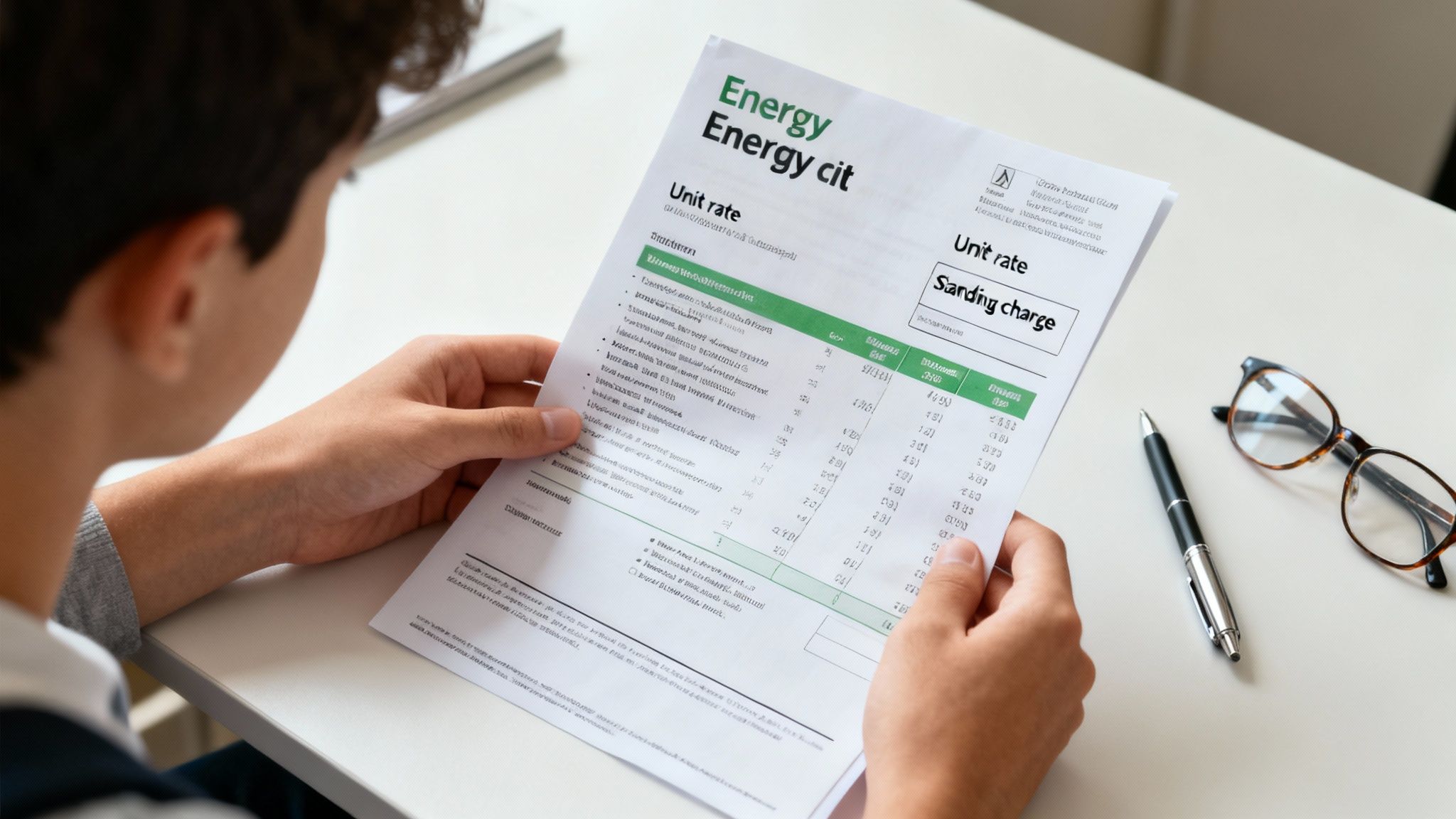
Before you even think about switching, you need to do a little recon work. That means grabbing a copy of your most recent energy bill. I know, it looks like a mess of confusing numbers and jargon, but trust me, it’s the key to unlocking a much, much better deal.
Think of it as your personal energy cheat sheet. Without it, you’re just guessing, and comparison sites will only be able to give you a vague estimate. We’ll show you exactly what to look for.
Find Your Tariff Name and Contract Details
Somewhere on your bill, usually right on the first page, you'll see the name of your current plan. It might be something catchy like "Student Saver Fix 2025" or a simple "Flexible Freedom." This name is your first clue—it tells you whether you're on a fixed or variable tariff.
Right near the tariff name, you should also spot your contract end date. This is super important. If you try to switch before this date, you could get slapped with an early exit fee, which can be anywhere from £30-£60 per fuel. Ouch. Knowing this date helps you time your switch perfectly to avoid any penalties.
Understand Your Energy Usage in kWh
To get a quote that’s actually accurate for your house, you need to know how much energy you’re using. Your bill will show this in kilowatt-hours (kWh). Look for a section called "Energy Usage" or maybe a little graph that breaks down your consumption over the past year.
This number is the holy grail for any comparison tool. It lets them calculate exactly what you’d pay with a different supplier, rather than giving you a generic guess based on the size of your house.
Your annual kWh usage is the single most important factor in finding an accurate quote. An estimate can be off by hundreds of pounds, so always use the real figures from your bill for the most reliable comparison.
Decode Your Unit Rate and Standing Charge
Finally, let’s break down how you’re actually being charged. Your total bill is made up of two main parts, and you’ll find them listed in the price breakdown section.
- Unit Rate: This is the price you pay for every single kilowatt-hour (kWh) of gas or electricity you use. It's usually shown in pence per kWh (p/kWh). For instance, your electricity unit rate might be 18p/kWh.
- Standing Charge: This is a fixed daily fee you pay just for being connected to the grid. It doesn't matter if you use a little or a lot of energy; you pay this every day to cover the cost of maintaining the pipes and wires to your home.
It’s easy to be tempted by a super-low unit rate, but a high standing charge can completely cancel out those savings. This is especially true for student houses, which are often empty during the long summer and Christmas holidays. You’ve got to compare both figures to find the supplier that’s genuinely the cheapest for you.
Using Comparison Websites to Find the Best Deals

Energy comparison websites are your secret weapon in this whole process. Think of them as the ultimate cheat sheet for finding the cheapest energy supplier. These free tools do all the heavy lifting, sifting through dozens of tariffs to find deals you’d probably never find on your own.
But just like shopping for anything else online, you wouldn't just grab the first thing you see. The headline price is designed to catch your eye, but the real value is hidden in the details. You've got to dig a little deeper to make sure you're not getting a dud deal.
Getting an Accurate Quote
First things first, you need to plug in your details, and getting this right is everything. For the most accurate results, grab the annual usage in kWh from your latest bill.
If you’ve just moved in and don’t have a bill yet, you can estimate based on the house size and how many of you are living there. Just remember this will only give you a ballpark figure, so the quotes won't be as precise. Once you’ve popped in your info, the website will spit out a list of potential suppliers, usually ranked by the cheapest estimated annual cost. This is your starting point, not the finish line.
Look Beyond the Headline Price
Okay, now it’s time to play detective. That initial list is great, but the cheapest deal on paper isn't always the best one for a student house. Trust me on this.
Here’s what you should be looking for to narrow down your search:
- Exit Fees: A deal might look cheap, but if it has a massive exit fee (think £30-£60 per fuel), you're basically locked in. I always tell students to hunt for tariffs with zero exit fees. It gives you the freedom to switch again if a better offer pops up.
- Customer Service Ratings: A rock-bottom price loses its appeal fast when you can’t get hold of anyone to fix a problem. Most comparison sites show customer service scores from proper independent surveys. Sometimes paying a tiny bit more for a highly-rated company saves you a world of headaches later.
- Tariff Type: Make sure you're comparing apples with apples. Use the filters to find the tariff type that suits you. For student budgeting, a fixed-rate tariff is usually the safest bet because it protects you from any surprise price hikes.
Remember, the cheapest energy supplier is the one that offers the best overall value, not just the lowest price per kWh. Consider exit fees, customer service, and any student-specific perks before making your final choice.
Spotting Whole-of-Market Comparisons
Here’s a crucial pro-tip: check if the comparison site shows you deals from the entire market or just a small group of providers they have deals with. A "whole-of-market" comparison gives you the full picture, making sure you don't miss out on a brilliant deal from a supplier that doesn't pay to be on the site.
You’ll often find a little checkbox to show all available plans, not just the ones you can switch to directly through them. Always tick this box. By investing a little extra time to compare your options properly, you can be confident you’ve found the absolute best deal for your house.
To see how finding the right deals can make a difference across all aspects of student life, you can learn more about https://studentwowdeals.com/how-it-works/.
Calculating the Real Cost of an Energy Deal
Don't get suckered in by a super-low unit rate. It's a classic trick. Suppliers will flash a tempting price per kilowatt-hour (kWh), but they'll often sting you with a massive daily standing charge to make up for it.
To figure out who's actually the cheapest, you need to do a tiny bit of maths. I promise it's simpler than it sounds.
You just need to combine the two main parts of any energy bill—the unit rate and the standing charge—with how much energy your house actually uses. This gives you an estimated yearly cost, which is the only number that really matters when you're comparing deals.
The Simple Formula for Your Annual Cost
Let's get this sorted. This is the one formula that cuts through all the marketing fluff and shows you the bottom line.
Here’s the basic calculation you'll need:
(Annual Usage in kWh × Unit Rate in pence) + (Standing Charge in pence × 365 days)
Just remember to divide the final number by 100 to get it into pounds. This quick sum gives you a clear, personalised estimate of what you’ll pay over a year, making it dead easy to compare offers accurately.
A Real-World Student House Example
Let's put this into practice. Imagine a typical student house with three people, which uses around 2,900 kWh of electricity per year. They're looking at two deals that both seem pretty good:
- Supplier A: Offers a crazy-low unit rate of 15p/kWh but has a hefty standing charge of 60p/day.
- Supplier B: Has a slightly higher unit rate of 17p/kWh but a much friendlier standing charge of 35p/day.
At first glance, Supplier A looks like the obvious winner with that cheap unit rate. But let’s run the numbers and see what's really going on.
Supplier A's Annual Cost:
(2,900 kWh × 15p) + (60p × 365) = 43,500p + 21,900p = £654.00Supplier B's Annual Cost:
(2,900 kWh × 17p) + (35p × 365) = 49,300p + 12,775p = £620.75
Would you look at that? Supplier B is actually over £33 cheaper for the year, even with the higher price per kWh.
This is exactly why you have to do the maths. A high standing charge can completely wipe out any savings from a low unit rate, especially in a student house that might be empty over the long summer holidays.
Factoring in Global Price Differences
It's also worth remembering that where you study can make a huge difference to your bills. Energy costs are wildly different across the globe.
For example, in Q4 2025, the world's average price for electricity at home was 17.0 U.S. cents per kWh. But while Asia was a more student-friendly 8.4 cents per kWh, Europe was a wallet-busting 25.5 cents per kWh. You can check out the full data on GlobalPetrolPrices.com to see how different countries stack up.
Ultimately, focusing on the total annual cost is the key. It’s the only way to make a smart choice that saves you real money every month, not just on paper.
Making the Switch Without the Headaches
So, you've crunched the numbers and found a deal that'll save you a decent chunk of change. Good news—the hardest part is over. Switching to a cheaper energy supplier is actually surprisingly simple, since your new provider does almost all the heavy lifting for you.
Once you’ve locked in your new plan online, the switch is officially in motion. Your new supplier will get in touch with your old one to sort out a handover date. The whole thing usually takes about 17 to 21 days, and a big part of that is your "cooling-off" period.
This is a 14-day window where you can change your mind and cancel the switch without getting hit with a penalty. It’s a legal requirement, giving you a safety net just in case you have second thoughts or, let's be honest, you spot an even better deal the next day.
Nailing the Final Meter Reading
One of the most common (and costly) mistakes people make is forgetting to give a final meter reading to their old supplier. This is a critical step, trust me.
Without it, your old provider has to guess your final bill, which—surprise, surprise—often means you get overcharged.
A few days before your official switch date, your new supplier will ping you a reminder to take a meter reading. Make sure you submit this to both your old and new suppliers. This ensures your final bill is spot on and your new account kicks off correctly. It’s a two-minute job that can save you a world of hassle.
Don't let a simple mistake cost you money. An accurate final meter reading means you only pay for the energy you've actually used, preventing a messy billing dispute with your old supplier later on.
The process of figuring out your final bill is a pretty straightforward mix of how much energy you used and what your tariff rates were.
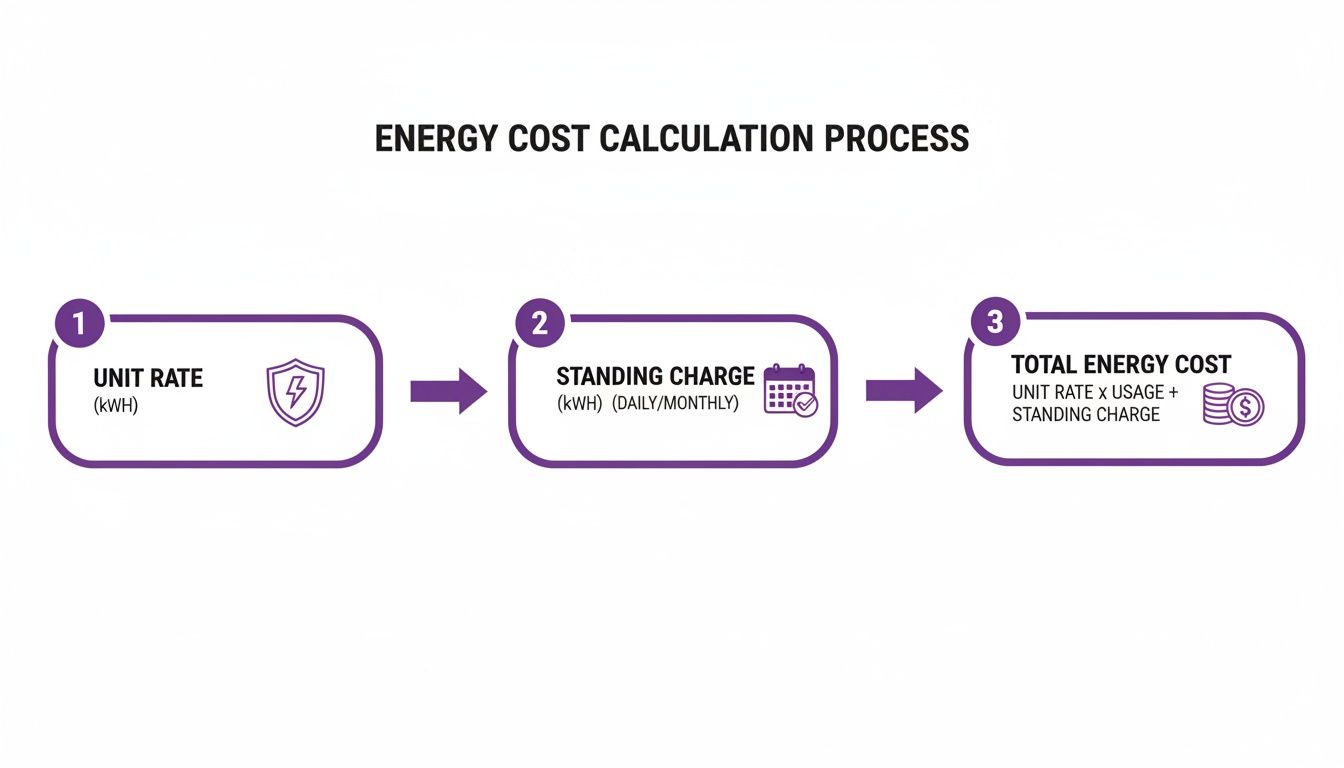
This graphic breaks down how your total bill comes together from the unit rate, your actual usage, and the daily standing charge. Getting your head around these three bits is key to making sure your bills are accurate, both now and in the future.
Navigating Bills in a Rented Property
What if you’re renting and your contract is "bills included"? In this case, the energy contract is in your landlord's name, not yours, so you can't just switch suppliers yourself.
But that doesn't mean you're stuck. You can still do the research and present your landlord with clear proof of how much could be saved by switching. A lot of landlords are pretty reasonable about this, especially if it means a happier tenant and lower costs for them in the long run.
The energy market is also tilting towards cheaper, greener options. By 2025, big investments in clean energy are really starting to shake up supplier costs. Solar and wind are now cheaper than fossil fuels in many places, with the Asia-Pacific region alone pouring over $1 trillion into this transition.
For students, this is great news. It means you can find much lower rates by picking suppliers that lean into renewables. You can dive deeper into these global electricity trends on Ember-energy.org.
Common Questions About Switching Energy Suppliers
Jumping into the world of energy deals can feel like a maze. To help you find your way, we've tackled the most common questions students have when it's time to find a cheaper supplier and make the move.
How Often Should I Look For a New Energy Deal?
A good rule of thumb is to start shopping around every 10-12 months, especially when your current fixed-rate deal is coming to an end. Why? Because the best rates are almost always introductory offers for new customers. Once your contract is up, you'll get dumped onto a much more expensive Standard Variable Tariff (SVT).
My advice? Set a calendar reminder a month before your contract expires. This gives you a nice cushion to browse, compare, and get your switch sorted without ever paying those sky-high SVT rates.
Will My Power Go Out During The Switch?
Nope, not a chance. This is probably the biggest myth out there, but your energy supply is 100% safe. The switch is purely administrative—it all happens behind the scenes.
Think about it: the same pipes and wires deliver energy to your house no matter who sends you the bill. Your new supplier simply tells your old one they're taking over from a specific date. The only thing you'll notice is a cheaper bill arriving.
The whole switching process is designed to be completely seamless. There are zero physical changes to your connection, so you can relax knowing your lights will stay on and your Wi-Fi will keep running without a single flicker.
Can I Switch Suppliers if I'm Renting?
This one comes down to a simple question: who pays the bill? If the energy bill is in your name and you pay the supplier directly, then you absolutely have the right to switch. Your landlord can't unreasonably stop you from finding a better deal.
However, if your bills are included in your rent, the contract is between your landlord and the supplier, so you can't switch on your own. In that case, you could try showing your landlord some of the cheaper deals you've found. If it saves them money, they might be willing to make the change. If you're stuck or unsure about your rental agreement, it's always a good idea to get in touch with a student support service for some advice.
What if I Move Out Before My Contract Ends?
Moving house mid-contract can sometimes trigger an early exit fee, which is why you should always check a supplier's moving policy before signing anything. As soon as you know you're moving, give your provider a call.
Many companies will let you transfer your tariff to your new address without any penalty. But if they don't supply your new area, or if you're moving into a place with bills included, you might have to pay that fee.
While UK energy prices can feel steep, it's interesting to see how much costs vary around the world. For example, households in Iran were paying just 0.2 U.S. cents per kWh in late 2023 because of the country's huge oil and gas reserves. You can discover more insights about these global price differences on Statista.com, where you'll see a typical monthly usage of 300 kWh would only cost about $0.60.
At Student Wow Deals, we're dedicated to helping you save on all aspects of student life, from energy bills to everyday essentials. Explore hundreds of exclusive discounts and offers for free at Student Wow Deals.