



Picking the right notebook is the secret weapon for effective note-taking. It’s about way more than just a cool cover. For most students, a spiral-bound notebook with college-ruled paper is a safe bet, giving you the flexibility for lectures and enough durability to survive a chaotic semester. But the perfect choice? That really comes down to your specific subjects and how your brain organizes information.
How To Choose The Right Notebook For Your Studies
Let's be real: the right paper, ruling, and binding can be the difference between beautifully organized notes and a chaotic mess you can't even read later. Getting these core components right is the first step toward finding a notebook that actually works with your learning style, not against it.
As you gear up for the new academic year, having a solid plan is key. A comprehensive Back To School Guide can help you sort through all the supplies you'll need. To simplify the notebook decision, this flowchart breaks down the key questions to ask yourself.
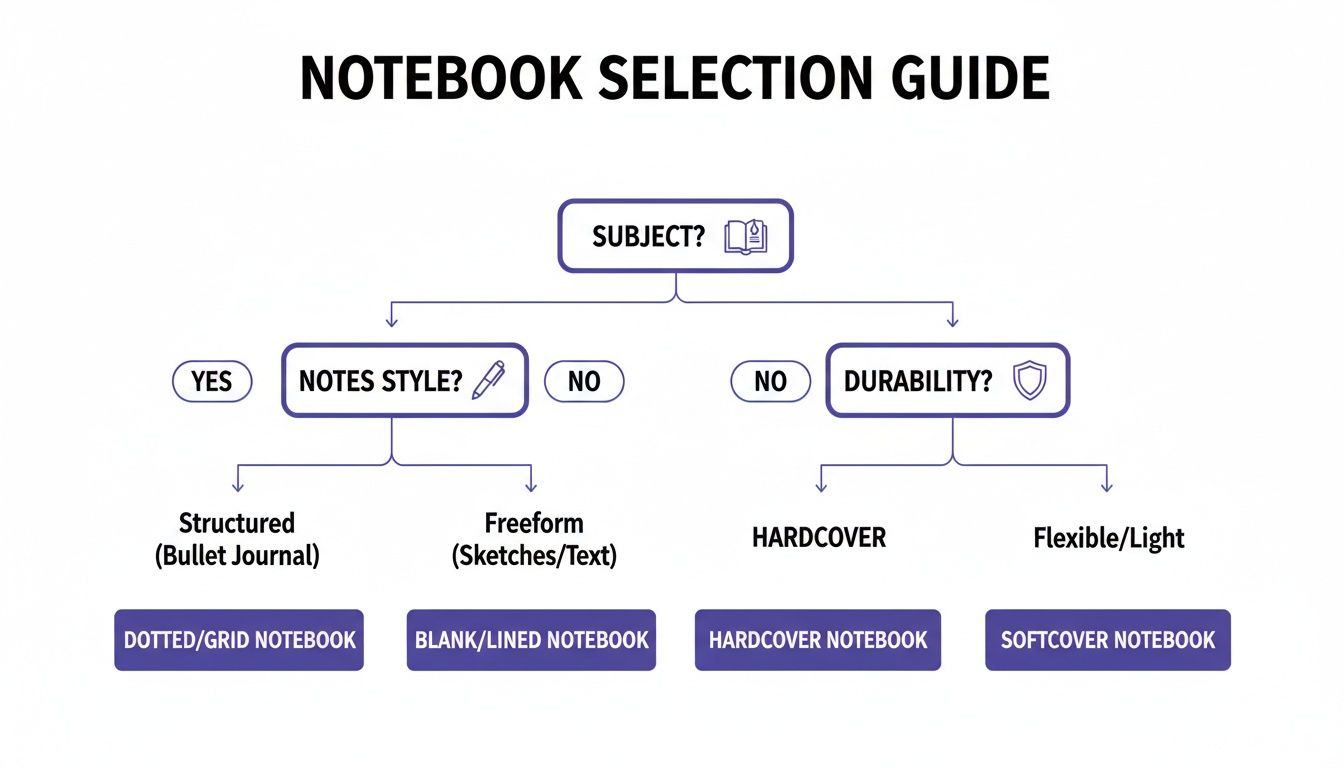
As you can see, it really boils down to three things: what you're studying, how you take notes, and how much abuse your notebook needs to withstand.
Paper Weight And Quality
Ever notice how some paper feels cheap and flimsy while other paper feels amazing to write on? That all comes down to paper quality, which is usually measured in GSM (grams per square meter). A higher GSM means thicker paper that can handle your favorite pens without bleeding ink through to the other side.
- 70-80 GSM: This is your standard, budget-friendly notebook paper. It works just fine for pencils and most ballpoint pens, but your gel pens or highlighters might bleed through.
- 90-100 GSM: A noticeable step up. This paper feels much smoother and can handle most pens without any annoying ghosting or bleed-through. It just makes for a nicer writing experience.
- 120+ GSM: Now we're talking premium stuff. This thick paper is a dream for artists, bullet journal fans, or anyone who loves using fountain pens and markers.
Finding Your Perfect Ruling
The lines on the page—the ruling—guide how you structure your thoughts. It’s a small detail that makes a huge difference, so don’t overlook it.
A notebook's ruling should complement your thought process. For linear thinkers in a history lecture, college-ruled is perfect. For a physics student sketching diagrams, grid paper is essential.
Think of it this way: the global paper notebook market is massive, projected to hit USD 76.28 billion by 2025 thanks to growing school enrollments. That growth means you have more choices than ever before, so you can find the exact ruling that fits your brain.
Binding Types And Durability
The binding is what holds it all together—literally. It also dictates how the notebook lays on your desk and whether it will survive being shoved into your backpack every day.
- Spiral-Bound: My personal favorite for lectures. It folds back on itself and lays perfectly flat, so you can use every inch of the page. The only downside is the wire can get bent out of shape.
- Composition (Stitched): These are built like tanks. The stitched binding and sturdy cover are made to last, though they don't always lay completely flat, which can be a pain.
- Disc-Bound: The ultimate in customization. This system lets you add, remove, and reorganize pages whenever you want. It’s perfect for creating a planner-notebook hybrid.
To make this even easier, here’s a quick-reference table to help you match notebook features to your specific classes and study habits.
Notebook Feature Decision Matrix for Students
| Feature Type | Option | Best For (Academic Use Case) | Consideration |
|---|---|---|---|
| Paper | 80 GSM | Everyday note-taking with ballpoint pens or pencils. | May cause ink bleed with heavier pens like markers. |
| Paper | 100+ GSM | Fountain pen users, art students, and detailed note-takers. | Tends to be more expensive and adds bulk. |
| Ruling | College-Ruled | Humanities, social sciences, and lecture-heavy courses. | Less flexible for diagrams or mathematical equations. |
| Ruling | Grid or Dotted | STEM subjects, design, data visualization, and mind mapping. | The structure can be distracting for pure text notes. |
| Binding | Spiral | Left-handed students and anyone needing a flat writing surface. | The wire can bend and snag on other items. |
| Binding | Composition | Long-term archival of notes for a single subject. | Does not lay perfectly flat, which can be awkward. |
Ultimately, choosing the right notebook is a personal decision, but armed with this knowledge, you can find one that feels less like a chore and more like a tool to help you succeed.
Comparing Notebooks for Different Academic Needs

Let's be real, picking a notebook isn't a one-size-fits-all deal. The notebook an engineering student needs to sketch out complex diagrams is worlds away from what a history major wants for pages of essay prep. Nailing down what you actually do in your classes is the secret to finding a tool that makes studying less of a drag.
The easiest way to figure this out is to think about a few classic student types. See which one sounds most like you, and you'll be able to cut through the noise and find your perfect match.
The STEM Major: Graphing and Formulas
If you’re deep in the world of science, tech, engineering, or math, you know precision is everything. Your notes are a wild mix of complex equations, detailed graphs, and step-by-step problem-solving. You need a notebook that gives you structure but doesn't box you in.
This is where grid-ruled notebooks are the unsung heroes. That quad-ruled paper is the perfect backbone for lining up numbers, sketching accurate diagrams, and creating neat data tables. It keeps your work from turning into a chaotic mess, which is a lifesaver when you're trying to review tricky calculus formulas.
A tough spiral binding is usually the way to go here. It lets the notebook lay completely flat or even fold back on itself, saving precious desk space in a packed lecture hall or a cramped lab.
The Arts and Humanities Scholar: Essays and Analysis
Got a schedule packed with literature, philosophy, or history? Your biggest need is simple: space to write. You're capturing lecture details, outlining massive essays, and pulling apart texts, so you need a notebook that lets your thoughts flow without interruption.
A classic college-ruled composition notebook or a high-quality lay-flat journal is your best bet. College ruling packs more lines onto each page, and a solid stitched binding means it'll survive being thrown in a bag all semester. A notebook that lays flat isn't just a nice-to-have; it's essential for writing comfortably across the entire page without wrestling with the spine.
The game-changer for a humanities major is the paper itself. Look for something with 90+ GSM paper to stop ink from bleeding through. It makes for a cleaner, more professional look and a much better writing experience, especially if you love gel or fountain pens.
The All-in-One Organizer: Juggling Multiple Subjects
Most students don't fall into one neat little box. One minute you're in a biology lab, the next you're in a Spanish class, and then you're off to a literature seminar. For you, the main battle is just staying organized. Your notebook has to be your command center.
This is where multi-subject spiral notebooks and disc-bound systems really come into their own. A 3- or 5-subject notebook with built-in dividers keeps everything separate but all in one place. No more grabbing the wrong notebook on your way out the door.
For total control, a disc-bound system is unbeatable. You can add, remove, and shuffle pages around however you want. You can even mix and match paper types—lined for one class, grid for another, and maybe some calendar pages for planning. It's a completely customizable setup for the student who's doing it all.
Student Persona Notebook Showdown
To simplify things even more, check out this table. It pits different notebook types against each other based on what different students actually need, helping you spot the right fit for your major in seconds.
| Student Persona | Recommended Notebook Type | Key Feature | Why It Works | Potential Drawback |
| :— | :— | :— | :— |
| The STEM Major | Grid-Ruled Spiral Notebook | Quad-ruling and lay-flat design | Perfect for aligning equations, graphing, and sketching diagrams in tight spaces. | The spiral wire can get bent or snag on items in a backpack. |
| Arts & Humanities | Lay-Flat Journal/Composition Book | High GSM, college-ruled paper | Supports extensive writing with various pens without ink bleed-through. | A fixed binding means pages cannot be easily removed or reordered. |
| All-in-One Organizer | Multi-Subject or Disc-Bound | Dividers or customizable pages | Consolidates all subjects into one portable system, enhancing organization. | Can become bulky and heavy when filled with multiple sections. |
Even with all the tech in the world, there's a reason paper notebooks are still everywhere. They’re reliable workhorses in schools and unis, with traditional notebooks making up 60% of school notebook units in 2023—that's about 250 million notebooks sold. This number is expected to hit 320 million by 2028 because, honestly, students love the simplicity. No batteries required when you're cramming for finals. You can read more about these stationery market trends to see how student needs are shaping the industry.
The Best Digital Notebooks for Modern Learning
The idea of a "notebook" isn't just about paper and ink anymore. These days, the best notebooks for students are often powerful digital sidekicks—part library, part research assistant, and part collaborative workspace, all rolled into one device. But diving into the world of laptops can feel like a chore with all the tech-speak and dizzying price tags.
The trick is to focus on what you'll actually be doing. The perfect machine for a creative writing major might buckle under the software demands of an engineering student. Let's break down the main categories so you can find the right fit for your classes and your wallet.
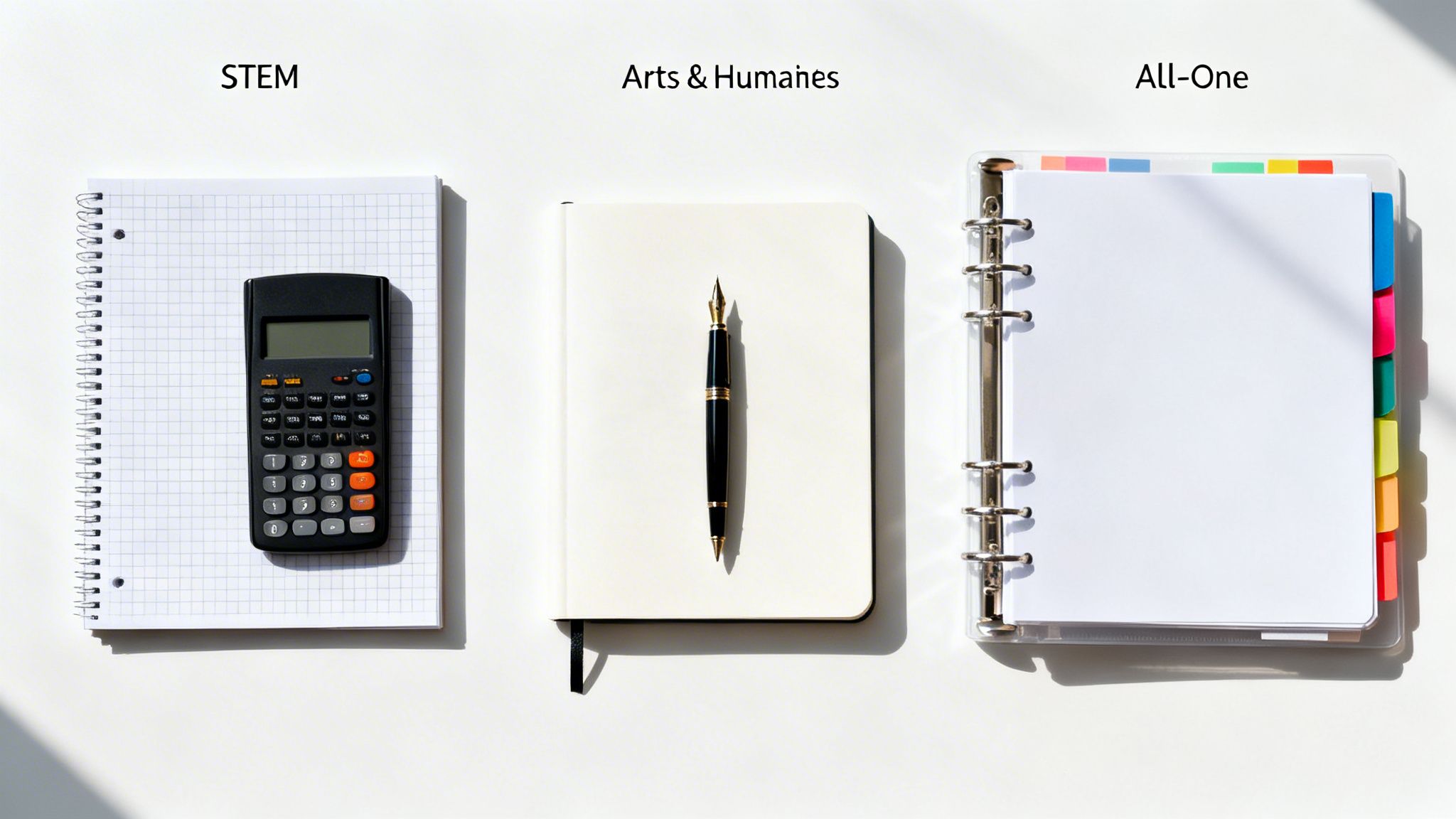
Just like the picture shows, different majors need different tools. That's just as true for your digital notebook as it is for your physical ones.
Lightweight Chromebooks for Everyday Essentials
Think of Chromebooks as the budget-friendly champions of speed and simplicity. They run on Google's ChromeOS, a super-light operating system built around web apps like Google Docs, Sheets, and Slides. This makes them a killer choice for students who live online—researching, writing essays, and working on group projects.
Because they're cloud-first, Chromebooks don't usually pack a ton of internal storage or raw processing power. The trade-off? They boot up in seconds and have amazing battery life, often lasting a full day of classes on a single charge.
If your degree is all about research, writing, and online teamwork, a Chromebook is a smart, affordable pick. It nails the core academic stuff without the hefty price tag or complexity of a traditional laptop.
Pairing a Chromebook with one of the best note-taking apps can seriously level up your study game. Many of these apps are web-based or have slick Android versions that run great on modern Chromebooks.
Versatile 2-in-1 Convertibles for Hands-On Learning
A 2-in-1 convertible gives you the best of both worlds: a real keyboard when you need to type and a hands-on tablet when you don't. With a touchscreen and often a stylus, these devices are a dream for students who need to mark up PDFs, sketch diagrams in a science lab, or jot down handwritten notes right on the screen.
This flexibility is a game-changer for visual learners and anyone in STEM or arts programs. Being able to go from typing an essay to drawing a chemical structure on the same device is just plain efficient. They might cost a bit more than a basic laptop, but their dual personality often makes it worth it.
Traditional Laptops for Power and Performance
For students tackling demanding fields like engineering, computer science, or video production, a traditional laptop is pretty much a must-have. These courses rely on specialized software that chews through processing power, graphics cards, and RAM. Skimping here isn't an option.
When you're shopping for a powerhouse laptop, keep an eye on these key specs:
- Processor (CPU): An Intel Core i5 or AMD Ryzen 5 is a solid starting point for most. If you’re running heavy-duty software, you'll want to step up to a Core i7 or Ryzen 7.
- RAM: 8GB is the absolute minimum for multitasking without wanting to throw your laptop out a window. I’d strongly recommend 16GB to handle beefier apps and future-proof your investment.
- Storage: A Solid State Drive (SSD) is non-negotiable for fast boot times and loading apps. Get at least 256GB, but spring for 512GB if you’ll be saving large project files.
- Battery Life: Look for something that promises 8-10 hours of life. The last thing you want is to be hunting for an outlet in the middle of a packed lecture hall.
The school notebook (laptop) market was worth around USD 19 billion in 2023 and is expected to hit USD 28.5 billion by 2032. While big names like Apple and HP still rule the roost, the growth of Chromebooks and 2-in-1s shows students are hungry for affordable, flexible options. If you've got your heart set on a Mac, our guide on the https://studentwowdeals.com/discounts/apple-student-discount/ can help make that price tag a little less painful.
Effective Strategies for Organizing Your Notes
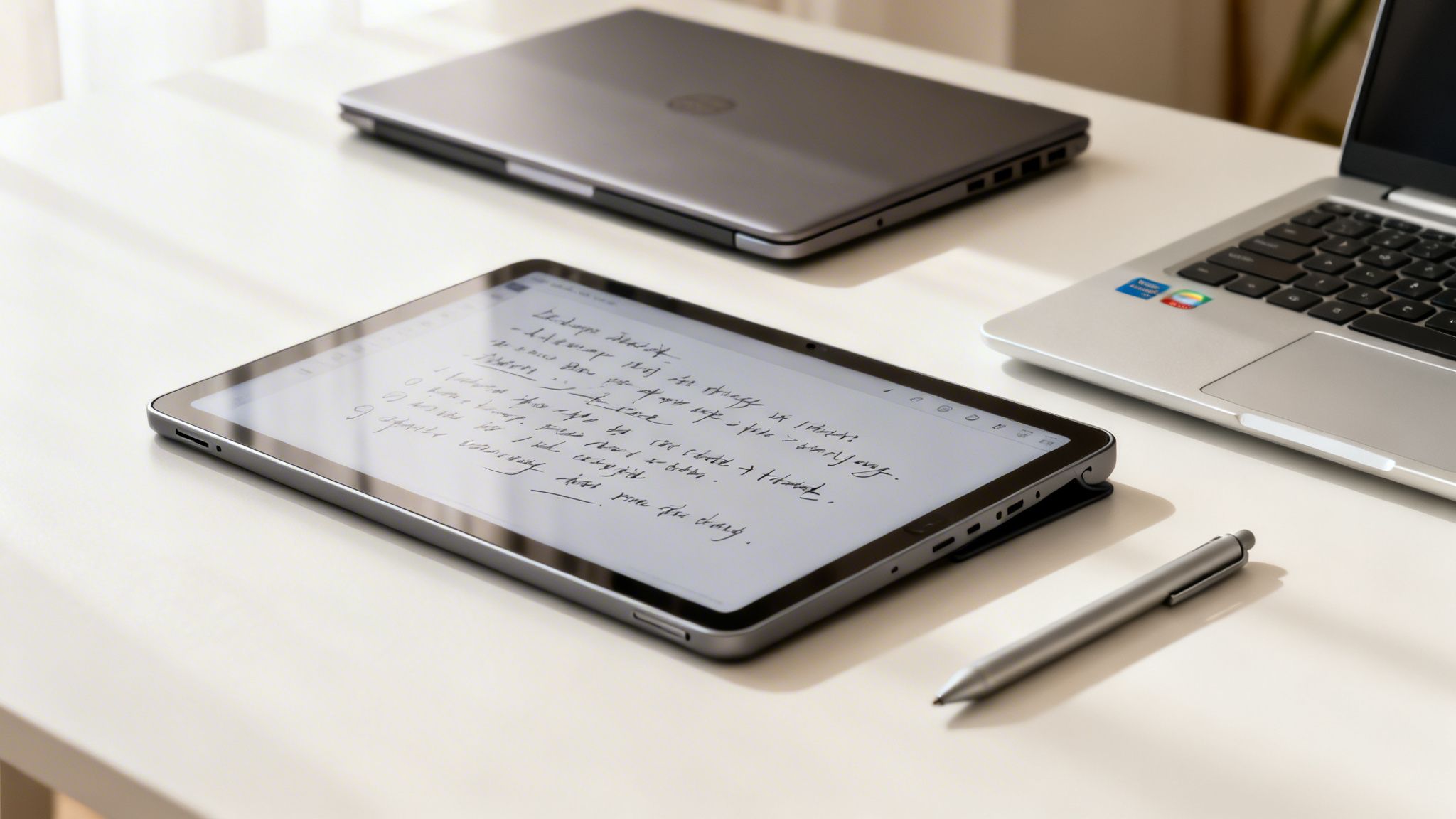
Grabbing the best notebooks is a great first step, but the real magic happens with how you use them. A great notebook is really just a blank canvas; a smart organizational system is what turns it into a serious tool for learning and revision. Let's be honest, just scribbling things down isn’t a strategy.
When you get structured, you stop being a passive listener and start becoming an active learner. This simple shift helps your brain actually process what you're hearing, making it way easier to remember key concepts when you're staring down an exam paper. The goal is to build a system that works for you, turning random lecture notes into a personalized study guide.
Choosing Your Note-Taking System
Different classes demand different tactics. A history lecture is a whole different beast from a chemistry lab, so you need to be flexible. Playing around with a few popular methods will help you figure out what clicks with your brain. There's no single "right" way—only the way that helps you get it.
Here are three proven systems to try out:
- The Cornell Method: This classic divides your page into three distinct zones. The big main section is for your in-class notes, a smaller column on the side is for key questions and cues, and the summary section at the bottom is for wrapping it all up after class. It literally forces you to review and think about what you just wrote.
- The Outlining Method: Perfect for lectures that have a clear, logical flow. This method uses headings and bullet points to build a hierarchy. Main topics get top billing, with sub-topics and details nested underneath. You can see how all the concepts connect at a single glance.
- Mind Mapping: For all the visual learners out there, this one’s a game-changer. You kick things off with a central idea in the middle of the page and then branch out with related concepts. Get creative with colours, symbols, and keywords to build a map of your ideas.
The best students I know don't just lock into one system. They’ll use the outlining method for a structured history lecture but then bust out a mind map for a creative writing brainstorm. The real skill is matching your strategy to the subject.
Maintaining an Organized System Across Classes
Trying to manage notes for multiple subjects can get chaotic, fast. Without a solid plan, you'll be drowning in loose pages by mid-semester. A little bit of organization at the start of the term pays off big time when you're cramming for finals.
Think about using a multi-notebook strategy to keep your subjects from blending together. For example, color-coding your notebooks is a dead-simple but super effective trick. Blue notebook for biology, red for history—it makes grabbing the right one on your way out the door completely automatic.
Another pro-level technique is creating a master index. Just leave the first couple of pages of each notebook blank. As you go, log important topics and their page numbers. Bam, you’ve just turned your notebook into a searchable database, saving you from flipping through a hundred pages to find one specific formula.
Keeping Your Notebooks in Top Condition
Your notebooks are holding onto some valuable info, so treat them right. A notebook that falls apart halfway through the semester means lost notes and a whole lot of unnecessary stress. A few simple habits can make your supplies last way longer.
- Reinforce the Weak Points: On spiral notebooks, run a strip of strong tape along the inside edge of the covers. This stops them from ripping off the wire coil when they're getting tossed around in your bag.
- Protect the Cover: A simple clear plastic cover or even some decorative contact paper can shield your notebook from spills, scuffs, and the general chaos of student life.
- Digitize for Safety: Get in the habit of using your phone to scan important pages. This creates a digital backup if your notebook ever goes missing and also makes your notes searchable. You can even use a Canva student discount code to turn your scans into slick, visually appealing digital summaries.
How to Find Great Deals on Student Notebooks
Let's be real, uni life costs enough without blowing your budget on the basics. Nailing down the perfect notebooks for your classes is one thing, but getting them for a bargain is a skill that’ll save you some serious cash over the semester. With a bit of savvy planning, you can get fully stocked without feeling the pinch.
The secret? It’s all in the timing. Big retailers drop their best discounts during predictable windows. If you’re ready to shop then, you can slash your supply costs. Waiting until the day before class is just asking to pay full price for whatever’s left.
Capitalize on Seasonal Sales Cycles
Most stores run on a pretty clear calendar when it comes to school supply deals. The biggest and most obvious one is the back-to-school season, which usually kicks off in late July and runs through early September. Retailers get super competitive during this time, so you’ll see rock-bottom prices on everything from basic spirals to fancy journals.
Another goldmine that people often miss is the end-of-semester clearance. When one term wraps up, stores are desperate to get rid of old stock. It’s an amazing time to find huge discounts, especially if you aren’t fussy about last season’s cover designs.
- Back-to-School (July-September): This is your prime time. You’ll find the biggest selection and insane "doorbuster" deals on multi-packs and other essentials.
- Post-Holiday Sales (January): As the new semester starts, a lot of stores have a second wave of sales to catch mid-year shoppers.
- End-of-Semester (May/December): Keep an eye out for clearance bins overflowing with unsold stock. The selection might be smaller, but the savings can be massive.
Use a Dedicated Student Discount Platform
Seasonal sales are awesome, but being a student can unlock savings all year round. This is where a platform like Student Wow Deals becomes your best friend. Instead of hopping between a dozen different websites, you get all the curated student discounts in one spot.
Honestly, it saves a ton of time and helps you find deals you’d probably miss otherwise. These platforms work directly with brands to offer exclusive codes and promos you can’t get anywhere else, covering both paper notebooks and digital gear.
For example, you might find a deal for a new ASUS digital notebook or snag discounts at office supply stores for all your paper needs. The platform even has a local deals finder, which shows you nearby businesses with student offers on a map. It makes saving money easy, whether you're shopping online or walking down the street. Learning how a Staples student discount works through a platform like this takes all the guesswork out of it.
Think of a student deals aggregator as your personal shopping assistant. It pulls together hundreds of offers, from year-round brand discounts to flash sales, so you never miss a chance to save on your uni essentials.
Smart Shopping Strategies for Maximum Savings
Beyond timing your shopping trips and using discount platforms, a few simple habits can stretch your budget even further. These small tweaks really add up over your time at uni.
- Buy in Bulk: It’s almost always cheaper to buy a multi-pack of single-subject notebooks than to buy them one by one. If you don't need a huge stack, go in with a roommate and split the cost.
- Check Community Programs: See if your uni or local community centres run programs that offer free or heavily subsidized school supplies. They’re there to help students manage costs and make sure everyone has what they need.
- Prioritize Value Over Brand Names: A premium brand can feel nice, but a lot of store-brand notebooks are just as good for a fraction of the price. Focus on what actually matters—the paper quality, binding, and ruling—not the logo on the front.
Combine these strategies, and you’ll be able to get the best notebooks for your classes without the financial stress. A little planning can turn buying supplies from a chore into a smart, money-saving win.
Frequently Asked Questions About Student Notebooks
It's one thing to read a guide, but another to feel totally confident before you spend your cash. We get it. Choosing the right notebook can feel surprisingly high-stakes when you’re trying to set yourself up for a great semester.
Let’s tackle some of the most common questions that pop up. These are the details that can trip you up, so let's get them sorted now so you can focus on your actual studies.
What Is the Best Notebook for Math and Science Classes?
For classes like math, physics, or chemistry, your notebook choice is non-negotiable. You’re going to be living in a world of equations, graphs, and complex diagrams, so you need something that works with you, not against you.
Your best bet is almost always a grid-ruled or quad-ruled spiral notebook. That grid gives you a subtle framework that makes it ridiculously easy to line up numbers, sketch straight axes for a graph, and just keep your work from turning into a chaotic mess. A spiral binding is the other hero here—it lets the notebook lie completely flat or fold back on itself, saving precious desk space in a packed lecture hall or a cramped lab station.
Are Expensive Notebook Brands Worth It for Students?
Ah, the classic debate. The honest answer? It depends. Sure, premium brands feel nice with their thicker paper and durable bindings, but you absolutely do not need to drop a fortune to get a solid notebook for class. For your everyday notes with a standard pen or pencil, a budget-friendly option from the campus bookstore will do the job just fine.
But there are a few times when splurging is actually a smart move:
- You're a fountain pen user or love inky markers: Go for a notebook with 100+ GSM paper. It’ll stop the ink from bleeding through and making a mess of the other side.
- You’re an art or design student: The quality of your paper directly impacts your work, period. In this case, better paper is a worthwhile investment in your grades.
- You need it to last for years: For those core classes where you know you'll be referencing your notes for future semesters, a sturdy, stitched binding will hold up way better than a spiral that’s bound to get bent out of shape in your backpack.
My rule of thumb is simple: match the notebook's quality to its purpose. If it's for disposable daily notes, go cheap. If it's for a semester-long project you'll need to look back on, investing in quality pays off.
How Many Notebooks Does a College Student Need?
This really depends on your course load and major. A good starting point for a full-time student taking four or five classes is to grab one single-subject notebook for each class. It’s the easiest way to keep everything separate and organized right from day one.
If you’d rather not juggle a whole stack of notebooks, you could go for one or two multi-subject notebooks (like a 3-subject or 5-subject spiral) to keep everything in one place. This is a great minimalist strategy, but you have to be disciplined about using the dividers so your chemistry notes don’t start bleeding into your English lit thoughts.
My advice? Start with the one-notebook-per-class plan. You can always adjust once you get a feel for how much you're writing in each course. It's way better to have an extra empty notebook on hand than to run out of paper mid-lecture.
Finding the best notebooks for your academic journey is easier when you have access to the right deals. Student Wow Deals is a free platform that gathers hundreds of exclusive discounts just for students, helping you save on everything from stationery and tech to food and fashion. Find exclusive student offers and start saving today at studentwowdeals.com.